Learn what every symbol on the card means.Full credits and sources at beakbrain.com/symbols
 WoodlandCup nestTiny · 10 g
ID tip
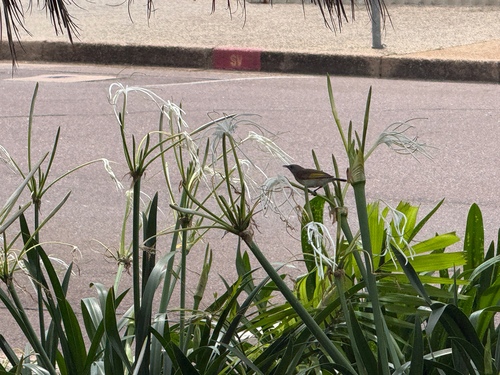
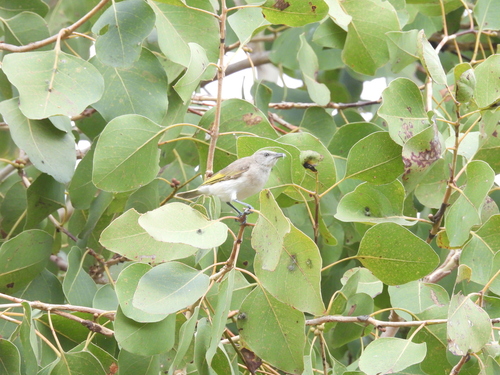
A tiny honeyeater, grey and discreet, with a nondescript colouration that is only faintly marked. The length is 10.5–12 cm (4.1–4.7 in). The plumage of the upper body is generally cold grey, the lower parts paler, becoming browner until a moult. Tail and flight feathers are a blackish brown, and a slightly darker marking extends across the eye to the bill. The tips of the tail feathers are white, aging to buffish. The bill is relatively short for a honeyeater, slightly down-curved and grey, becoming black toward the tip. Voice: The most common call of the grey honeyeater has been described as a piercing, metallic, quick, double squeak "chirra-wik-chirra-wik", or "cre-seek" and somewhat resembling the call of the white-bellied cuckooshrike (Coracina papuensis). It also makes a weak, grating, high-pitched tinkling or a plaintive series of notes given in quick succession, sounding like "troo-whee, troo-whee".
Text from Wikipedia, licensed CC BY-SA 4.0.
When to see the Grey Honeyeater
One bar for each month. Filled bars are the 9 months with records; pale bars are months with none. The wide bar is October, the month with the most records.
Where to see the Grey Honeyeater
The map shades 1 country with regular records. Everything unshaded has no records. Countries are listed below the map.
About the Grey Honeyeater
The grey honeyeater is a species of bird in the honeyeater family. It is an uncommon and little-known bird, an often overlooked endemic of remote areas in central Australia.
Text adapted from Wikipedia, licensed CC BY-SA 4.0.
Easily confused with
Learn the Grey Honeyeater in the BeakBrain App
Photo and call practice. Coming soon to iPhone and Android.
Play today's Daily BirdEvery photo and recording on this page is credited to its author under the licence shown. Spotted a problem with this page, or have a better photo? Contribute.