Learn what every symbol on the card means.Full credits and sources at beakbrain.com/symbols
 ForestCavity nestMedium · 137 g




What the Grey-headed Woodpecker sounds like


ID tip
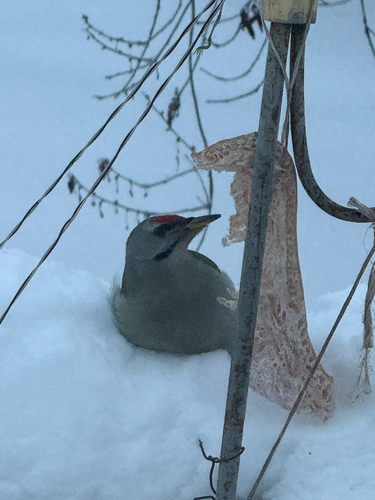
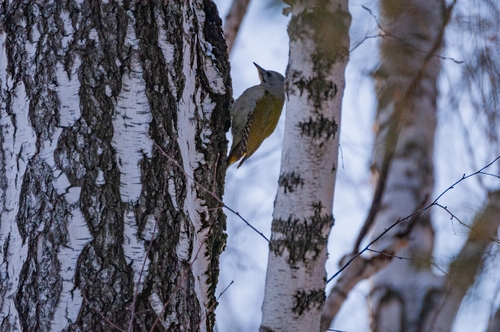
The grey-headed woodpecker is 25–26 cm (9.8–10.2 in) in length, has a wingspan of 38–40 cm (15–16 in) and weighs around 125 g (4.4 oz). The male of the nominate subspecies has a grey head with a red forecrown. There is a black line across the lores and a narrow black moustache stripe. The back, scapulars and wing coverts are green. The breast and underbody are pale grey. The folded primaries are barred brown-black on grey-white. The female lacks the red forecrown but has fine black streaks on the crown. Voice: Calls made by the European green woodpecker and grey-headed woodpecker resemble each other. The far-carrying territorial song of the grey-headed woodpecker is more melodic and cleaner than the explosive "laughter" of the green woodpecker. The call series consists of ten to fifteen utterances of declining pitch and gradual slowing. The verse may appear melancholic and "dying".
Text from Wikipedia, licensed CC BY-SA 4.0.
When to see the Grey-headed Woodpecker
One bar for each month. Filled bars are the 10 months with records; pale bars are months with none. The wide bar is March, the month with the most records.
Where to see the Grey-headed Woodpecker
The map shades 52 countries with regular records, and 3 more in a lighter tone where the bird turns up only as a stray. Everything unshaded has no records. Countries are listed below the map.
Recorded as a rare visitor in Belgium, Netherlands, Malaysia.
About the Grey-headed Woodpecker
The grey-headed woodpecker, also known as the grey-faced woodpecker, is a Eurasian member of the woodpecker family, Picidae. Along with the more commonly found European green woodpecker and the Iberian green woodpecker, it is one of three closely related species found in Europe. Its distribution also stretches across large parts of the central and Eastern Palaearctic, all the way to the Pacific Ocean and south to the Himalaya and the Malay Peninsula.
Text adapted from Wikipedia, licensed CC BY-SA 4.0.
Easily confused with
 Iberian Green WoodpeckerPicus sharpeiThe Iberian green woodpecker is a medium-sized woodpecker endemic to the Iberian peninsula.
 Lesser YellownapePicus chlorolophusThe lesser yellownape is a largish species at 27 cm in length.
 Streak-throated WoodpeckerPicus xanthopygaeusA medium-sized, green woodpecker with streaked throat and scaly whitish underparts.
Side by side: European Green Woodpecker vs Grey-headed Woodpecker · Grey-headed Woodpecker vs Lesser Yellownape · Grey-headed Woodpecker vs Streak-throated Woodpecker
Learn the Grey-headed Woodpecker in the BeakBrain App
Photo and call practice. Coming soon to iPhone and Android.
Play today's Daily BirdEvery photo and recording on this page is credited to its author under the licence shown. Spotted a problem with this page, or have a better photo? Contribute.