Learn what every symbol on the card means.Full credits and sources at beakbrain.com/symbols
 ForestCup nestLarge · 395 g


ID tip
A larger and more slender bird than its more common relative the pied currawong, the adult grey currawong ranges from 44 to 57 cm (17 to 22 in) in length, with an average of around 52 cm (20 in); the wingspan varies from 72 to 85 cm (28 to 33 in), averaging around 78 cm (31 in), with an average weight of around 350 g (12 oz). Adults of the Tasmanian subspecies average around 440 g (16 oz). The male is on average slightly larger than the female, but the size and weight ranges mostly overlap. Voice: Unlike that of the pied currawong, the grey currawong's call does not sound like its name. The grey currawong is best known for making a sound variously transcribed as p'rink, clink, cling, ker-link or tullock, either in flight or when gathered in any numbers.
Text from Wikipedia, licensed CC BY-SA 4.0.
When to see the Grey Currawong
One bar for each month, and every month is filled: this bird is recorded here in all twelve. The wide bar is October, the month with the most records.
Where to see the Grey Currawong
The map shades 1 country with regular records. Everything unshaded has no records. Countries are listed below the map.
About the Grey Currawong
The grey currawong is a large passerine bird native to southern Australia, including Tasmania. One of three currawong species in the genus Strepera, it is closely related to the butcherbirds and Australian magpie of the family Artamidae. It is a large crow-like bird, around 48 cm (19 in) long on average; with yellow irises, a heavy bill, dark plumage with white undertail and wing patches. The male and female are similar in appearance.
Text adapted from Wikipedia, licensed CC BY-SA 4.0.
Easily confused with
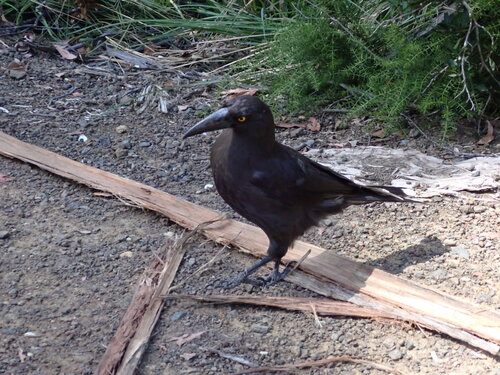 Black CurrawongStrepera fuliginosaThe black currawong is about 50 cm (20 in) long with an 80 cm (31 in) wingspan.
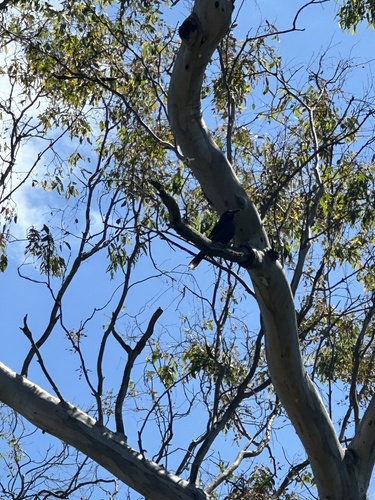 Pied CurrawongStrepera graculinaThe pied currawong is generally a black bird with white in the wing, undertail coverts, the base of the tail and most visibly, the tip of the tail.
Side by side: Grey Currawong vs Pied Currawong · Black Currawong vs Grey Currawong
Learn the Grey Currawong in the BeakBrain App
Photo and call practice. Coming soon to iPhone and Android.
Play today's Daily BirdEvery photo and recording on this page is credited to its author under the licence shown. Spotted a problem with this page, or have a better photo? Contribute.