Learn what every symbol on the card means.Full credits and sources at beakbrain.com/symbols
 WetlandPlatform nestMedium · 202 g


What the Green Heron sounds like


ID tip
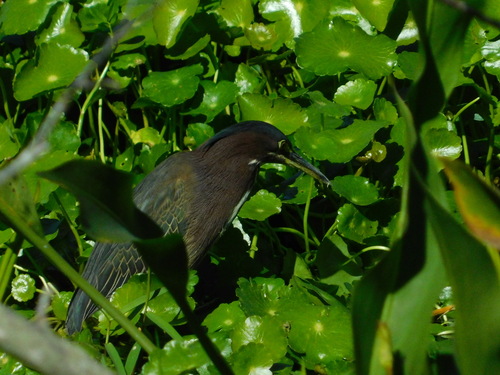
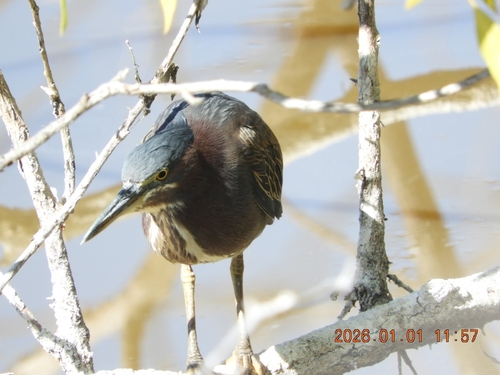
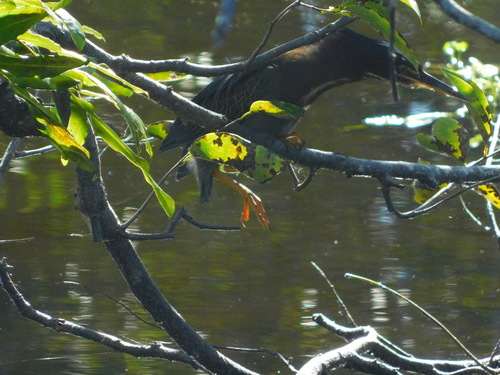
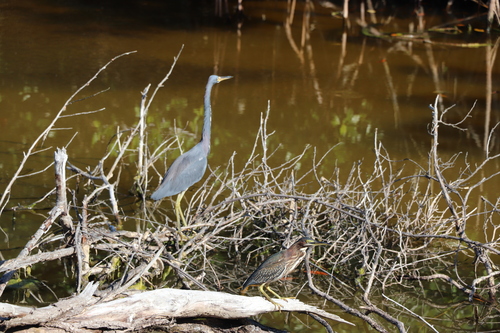
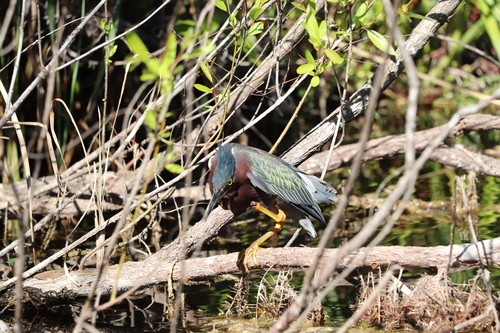
The green heron is a relatively small heron; adult body length is about 44 cm (17 in). The neck is often pulled in tight against the body. Adults have a glossy, greenish-black cap, an iridescent greenish back and wings that are gray-black grading into green or blue, a chestnut neck with a pair or more of white lines down the front, gray underparts and short yellow legs. The bill is dark with a long, sharp point. Female adults tend to be smaller than males, and have duller and lighter plumage, particularly in the breeding season.
Text from Wikipedia, licensed CC BY-SA 4.0.
When to see the Green Heron
One bar for each month. Filled bars are the 9 months with records; pale bars are months with none. The wide bar is May, the month with the most records.
Where to see the Green Heron
The map shades 44 countries with regular records, and 6 more in a lighter tone where the bird turns up only as a stray. Everything unshaded has no records. Countries are listed below the map.
Recorded as a rare visitor in United Kingdom, France, Netherlands, Iceland, Ireland, Sweden.
About the Green Heron
The green heron is a small heron of North and Central America. Butorides is from Middle English butor "bittern" and Ancient Greek -oides, "resembling", and virescens is Latin for "greenish".
Text adapted from Wikipedia, licensed CC BY-SA 4.0.
Easily confused with
 Striated HeronButorides striataThe striated heron is 35–48 cm (14–19 in) in length, weighs 130–250 g (4.6–8.8 oz) and has a wing-span of 52–60 cm (20–24 in).
 Lava HeronButorides sundevalliThe adult is slate-grey to black, which allows it to blend in with the hardened lava.
 Little HeronButorides atricapillaThe little heron is 35–48 cm (14–19 in) in length, weighs 130–250 g (4.6–8.8 oz) and has a wing-span of 52–60 cm (20–24 in).
Side by side: Green Heron vs Striated Heron
Learn the Green Heron in the BeakBrain App
Photo and call practice. Coming soon to iPhone and Android.
Play today's Daily BirdEvery photo and recording on this page is credited to its author under the licence shown. Spotted a problem with this page, or have a better photo? Contribute.