Learn what every symbol on the card means.Full credits and sources at beakbrain.com/symbols
 WetlandScrapeMedium · 162 g


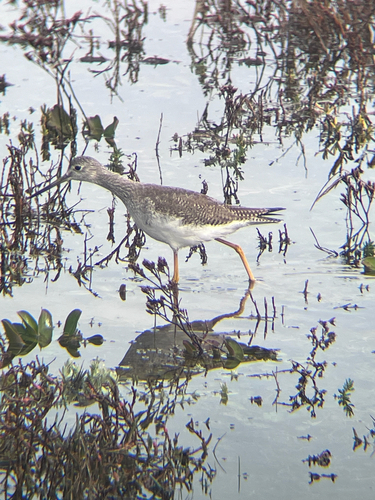
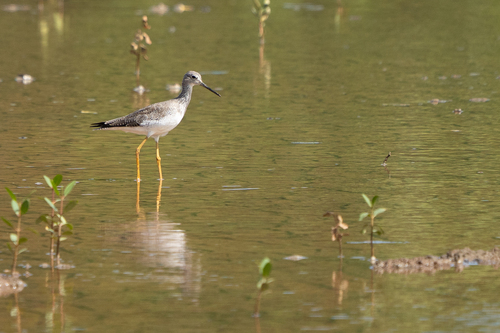
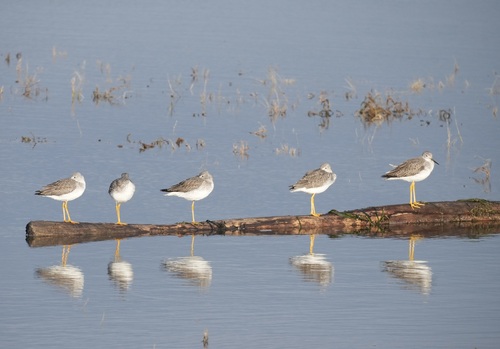
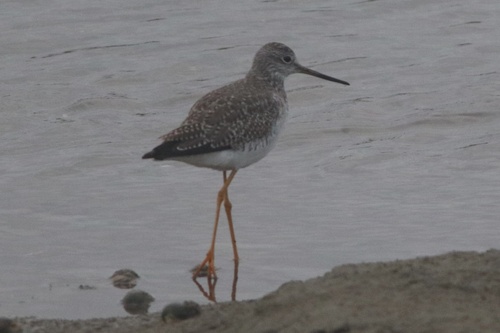
What the Greater Yellowlegs sounds like


ID tip
The greater yellowlegs is similar in appearance to the smaller lesser yellowlegs. Its closest relative, however, is the greenshank, which together with the spotted redshank form a close-knit group. Among them, these three species show all the basic leg and foot colours found in the shanks, demonstrating that this character is paraphyletic. They are also the largest shanks apart from the willet, which is altogether more robustly built.
Text from Wikipedia, licensed CC BY-SA 4.0.
When to see the Greater Yellowlegs
One bar for each month. Filled bars are the 11 months with records; pale bars are months with none. The wide bar is April, the month with the most records.
Where to see the Greater Yellowlegs
The map shades 57 countries with regular records, and 8 more in a lighter tone where the bird turns up only as a stray. Everything unshaded has no records. Countries are listed below the map.
Recorded as a rare visitor in Norway, Netherlands, Spain, Belgium, Japan, France, Denmark, Iceland.
About the Greater Yellowlegs
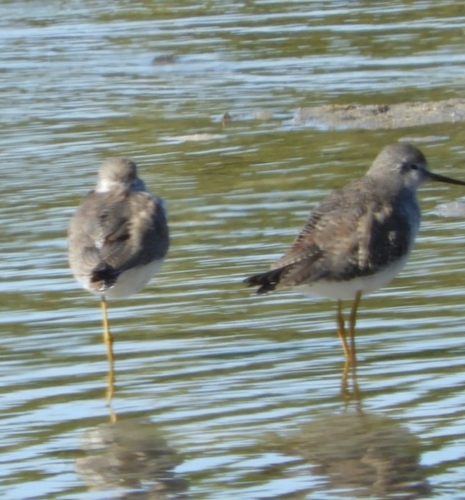
The greater yellowlegs is a large shorebird in the family Scolopacidae. It breeds in central Canada and southern Alaska and winters in southern North America, Central America, the West Indies and South America.
Text adapted from Wikipedia, licensed CC BY-SA 4.0.
Easily confused with
 Lesser YellowlegsTringa flavipesThe lesser yellowlegs is a medium-large shorebird, 23–25 cm (9.1–9.8 in) in overall length and with a wingspan of 59–64 cm (23–25 in) and a weight of 67–94 g (2.4–3.3 oz).
 WilletTringa semipalmataThe willet is a particularly elegant and heavily built shorebird with a structure similar to that of the common redshank but being larger in size than the greater yellowlegs while resembling a godwit in flight with black primary coverts and primaries contrasting with a broad white band, white secondaries with a white rump and gray tail band.
 Common RedshankTringa totanusCommon redshanks in breeding plumage are a marbled brown color, slightly lighter below.
Side by side: Greater Yellowlegs vs Lesser Yellowlegs · Greater Yellowlegs vs Willet · Common Redshank vs Greater Yellowlegs
Learn the Greater Yellowlegs in the BeakBrain App
Photo and call practice. Coming soon to iPhone and Android.
Play today's Daily BirdEvery photo and recording on this page is credited to its author under the licence shown. Spotted a problem with this page, or have a better photo? Contribute.