Learn what every symbol on the card means.Full credits and sources at beakbrain.com/symbols
 ForestCavity nestLarge · 1.4 kg


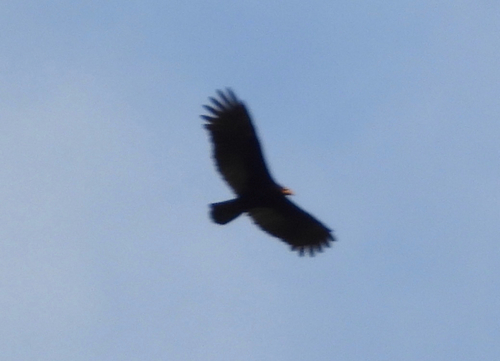
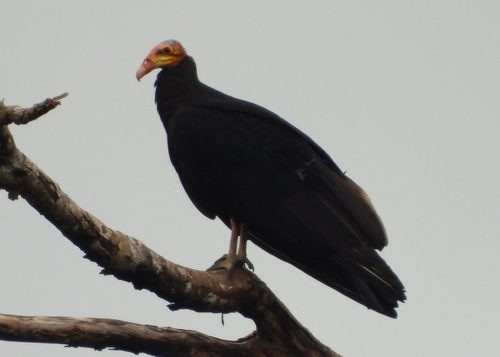


ID tip
The greater yellow-headed vulture is 64–75 centimetres (25–30 in) in length, with a wingspan of 166–178 centimetres (65–70 in), a tail length of 25–29 centimetres (9.8–11.4 in) and a weight averaging 1.65 kilograms (3.6 lb). Its plumage is black with a green or purple sheen. The throat and the sides of the head are featherless. The skin on the head ranges in color from deep yellow to pale orange with a blue crown. The nape and the area near the nostrils are pale pinkish. The undersides of the wings are black, while the flight feathers are a lighter shade.
Text from Wikipedia, licensed CC BY-SA 4.0.
When to see the Greater Yellow-headed Vulture
One bar for each month, and every month is filled: this bird is recorded here in all twelve. The wide bar is October, the month with the most records.
Where to see the Greater Yellow-headed Vulture
The map shades 9 countries with regular records. Everything unshaded has no records. Countries are listed below the map.
About the Greater Yellow-headed Vulture
The greater yellow-headed vulture, also known as the forest vulture, is a species of bird in the New World vulture family Cathartidae. It was considered to be the same species as the lesser yellow-headed vulture until they were split in 1964. It is found in South America in tropical moist lowland forests. It is a fairly large bird, with a wingspan of 166–178 cm (65–70 in), a weight of 1.65 kilograms (3.6 lb) and a body length of 64–75 cm (25–30 in). The body plumage is black, and the head and neck, which are featherless, range in color from deep yellow to pale orange. It lacks a syrinx, and its vocalizations are therefore limited to grunts or low hisses.
Text adapted from Wikipedia, licensed CC BY-SA 4.0.
Easily confused with
 Lesser Yellow-headed VultureCathartes burrovianusThis is the lightest and smallest of the extant New World vultures despite sometimes measuring at least as long and longer winged than black vultures.
 Turkey VultureCathartes auraA large bird, it has a wingspan of 1.5–2 m (4.9–6.6 ft) a length of 62–81 cm (24–32 in), and weight of 0.8 to 2.41 kg (1.8 to 5.3 lb).
Side by side: Greater Yellow-headed Vulture vs Turkey Vulture · Greater Yellow-headed Vulture vs Lesser Yellow-headed Vulture · Greater Yellow-headed Vulture vs King Vulture · Andean Condor vs Greater Yellow-headed Vulture
Learn the Greater Yellow-headed Vulture in the BeakBrain App
Photo and call practice. Coming soon to iPhone and Android.
Play today's Daily BirdEvery photo and recording on this page is credited to its author under the licence shown. Spotted a problem with this page, or have a better photo? Contribute.