Learn what every symbol on the card means.Full credits and sources at beakbrain.com/symbols
 ShrublandCup nestTiny · 11 g

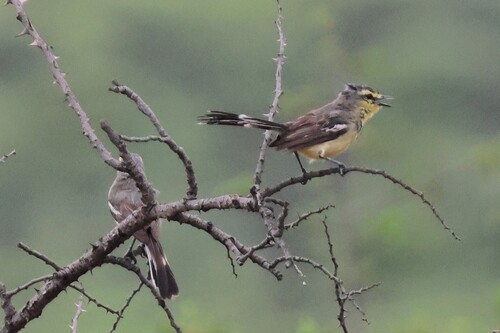
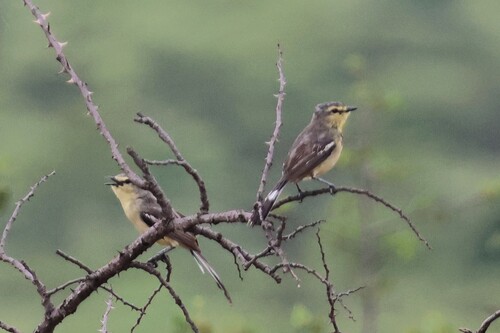
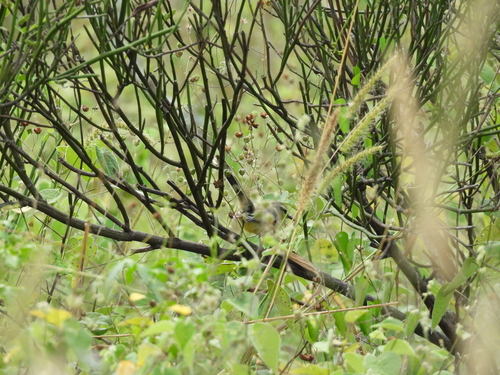
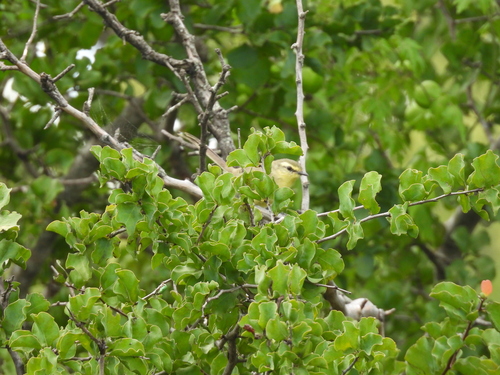
ID tip
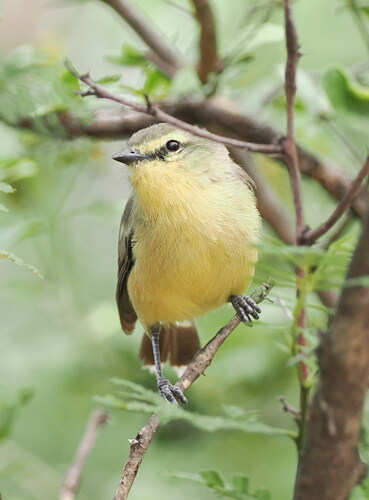
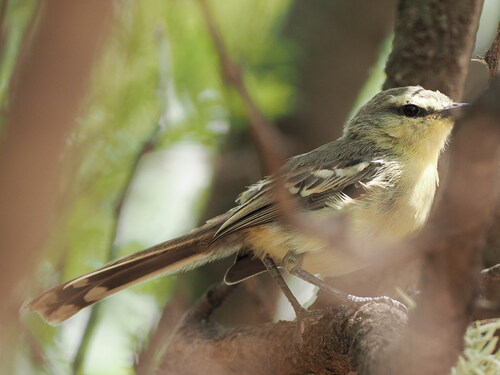
The greater wagtail-tyrant is 14 to 16 cm (5.5 to 6.3 in) long and weighs 8.5 to 13.2 g (0.30 to 0.47 oz). The sexes have the same plumage; males are slightly larger than females. The nominate subspecies S. b. budytoides is the largest and S. b. gracilis is the smallest. Adults of the nominate subspecies have a bright yellow supercilium from the bill to past the eye, a blackish line through the eye, and dusky ear coverts on an otherwise yellowish face. Their crown and upperparts are grayish olive. Voice: Greater wagtail pairs often sing in duet, a "high, liquid series of 'Wee-tjer- -' from one bird and 'tidrrr- -' from the other". The two vocalizations are also described as "whididideteh" and "tri-ti-treeowhit". The species also makes an "brupt 'churt', sometimes in series, varied occasionally into more complex chatter".
Text from Wikipedia, licensed CC BY-SA 4.0.
When to see the Greater Wagtail-Tyrant
One bar for each month, and every month is filled: this bird is recorded here in all twelve. The wide bar is October, the month with the most records.
Where to see the Greater Wagtail-Tyrant
The map shades 4 countries with regular records. Everything unshaded has no records. Countries are listed below the map.
About the Greater Wagtail-Tyrant
The greater wagtail-tyrant is a species of bird in the family Tyrannidae, the tyrant flycatchers. It is found in Argentina, Bolivia, Brazil, and Paraguay.
Text adapted from Wikipedia, licensed CC BY-SA 4.0.
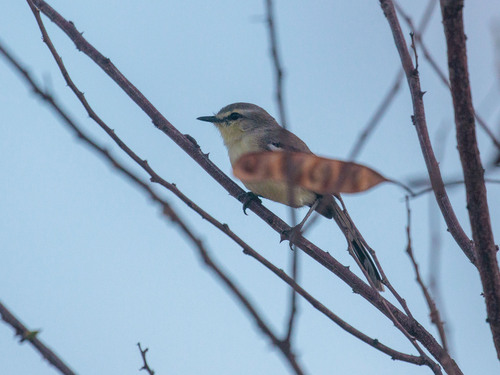
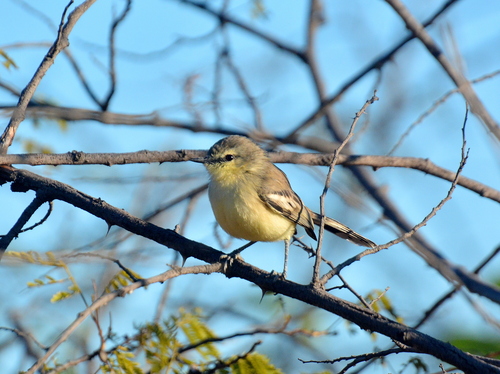
Easily confused with
Learn the Greater Wagtail-Tyrant in the BeakBrain App
Photo and call practice. Coming soon to iPhone and Android.
Play today's Daily BirdEvery photo and recording on this page is credited to its author under the licence shown. Spotted a problem with this page, or have a better photo? Contribute.