Learn what every symbol on the card means.Full credits and sources at beakbrain.com/symbols
 ForestCavity nestLarge · 525 g


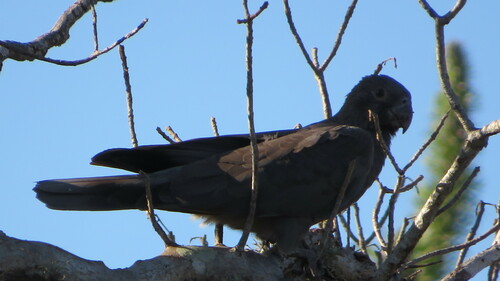
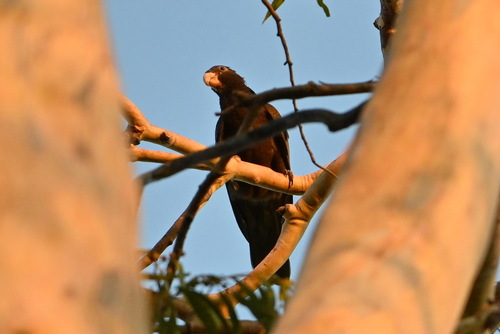
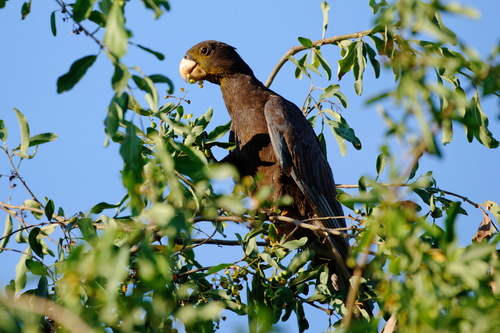
ID tip
The greater vasa parrot's breeding season is uncertain, but is probably between October and December. It has a very unusual breeding biology and mating system; females are 25% larger than males, and are, physically, dominant. The species lives in loose, polygynandrous groups wherein each female has at least 3-8 sexual partners. The males have re-evolved a phallus, and copulations can last up to 90 minutes. Copulations come in two lengths—short (1–3 seconds) and long durations (averaging 36 minutes), with the latter involving a copulatory tie.
Text from Wikipedia, licensed CC BY-SA 4.0.
When to see the Greater Vasa Parrot
One bar for each month. Filled bars are the 5 months with records; pale bars are months with none. The wide bar is November, the month with the most records.
Where to see the Greater Vasa Parrot
The map shades 2 countries with regular records. Everything unshaded has no records. Countries are listed below the map.
About the Greater Vasa Parrot
The greater vasa parrot is one of two species of vasa parrot, the other being the lesser vasa parrot. The greater vasa parrot can be found throughout Madagascar and the Comoros.
Text adapted from Wikipedia, licensed CC BY-SA 4.0.
Easily confused with
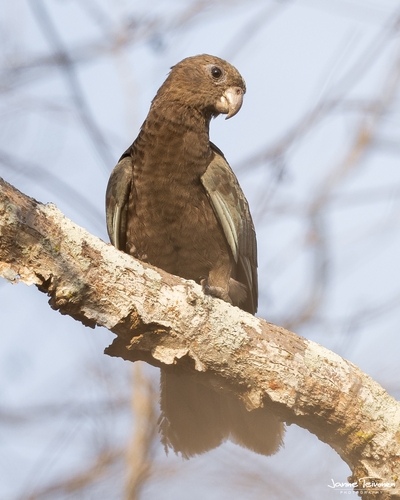 Lesser Vasa ParrotCoracopsis nigraThe lesser vasa parrot or black parrot is a black coloured parrot endemic to most of Madagascar.
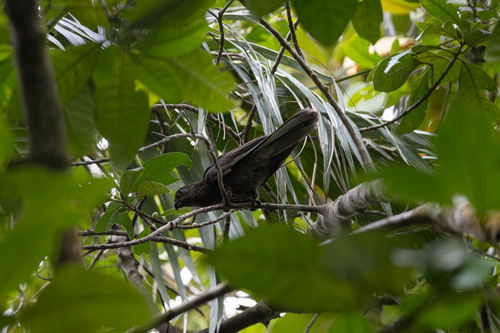 Seychelles Black ParrotCoracopsis barklyiThe Seychelles black parrot is entirely dark grey-brown except for greyish undertail-coverts; the dark bill becomes paler during the breeding season.
 Comoro Black ParrotCoracopsis sibilansThe Comoros black parrot is a medium-sized parrot endemic to the Comoros.
Learn the Greater Vasa Parrot in the BeakBrain App
Photo and call practice. Coming soon to iPhone and Android.
Play today's Daily BirdEvery photo and recording on this page is credited to its author under the licence shown. Spotted a problem with this page, or have a better photo? Contribute.