Learn what every symbol on the card means.Full credits and sources at beakbrain.com/symbols
 ForestCavity nestMedium · 71 g

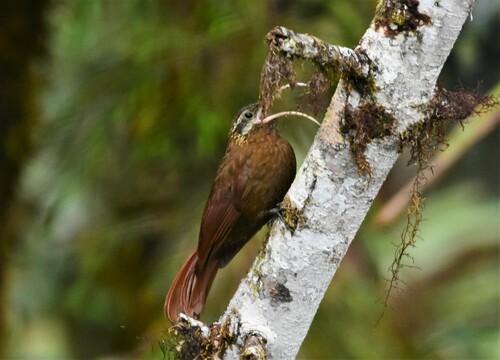
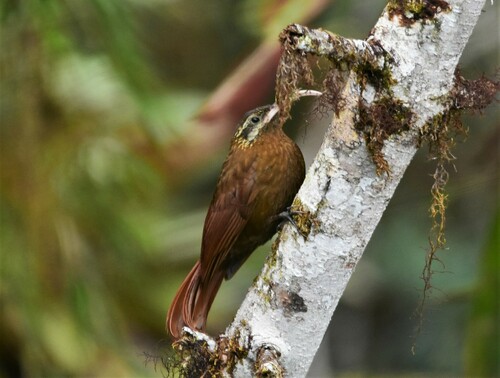
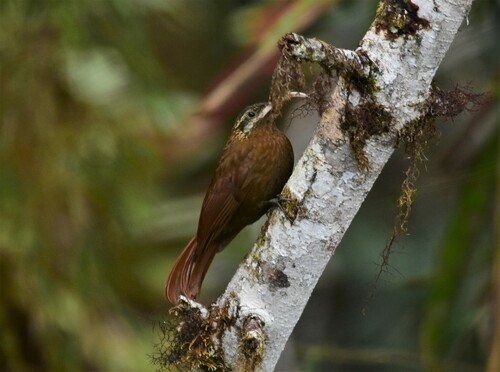
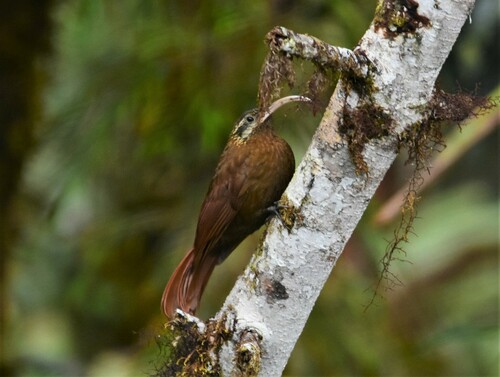
What the Greater Scythebill sounds like

ID tip
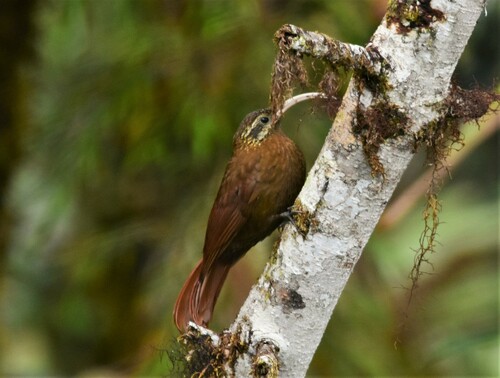
The greater scythebill is 24 to 30 cm (9.4 to 12 in) long and weighs 63 to 78 g (2.2 to 2.8 oz). It is the largest and heaviest scythebill with a shorter, stouter, and less curved bill than the others. The sexes have the same plumage. Adults have blackish brown ear coverts, a distinct whitish supercilium, and an even bolder whitish moustachial stripe. Their upperparts are dull rufous brown to chestnut with a darker crown. Their crown and nape have thin buff streaks that sometimes continue onto the upper back. Their rump, wings, and tail are dark rufous-chestnut. Voice: The greater scythebill's song is described as an "alternating series of twitters and nasal 'ik' notes" and by another author as "a rather weak and nasal, ascending 'ee-ee-ee-ee-ee-énh' ". It is very different from those of all other scythebills.
Text from Wikipedia, licensed CC BY-SA 4.0.
When to see the Greater Scythebill
One bar for each month. Filled bars are the 11 months with records; pale bars are months with none. The wide bar is December, the month with the most records.
Where to see the Greater Scythebill
The map shades 3 countries with regular records. Everything unshaded has no records. Countries are listed below the map.
About the Greater Scythebill
The greater scythebill is a species of suboscine passerine bird in the subfamily Dendrocolaptinae of the ovenbird family Furnariidae. It is found in Colombia, Ecuador, and Peru.
Text adapted from Wikipedia, licensed CC BY-SA 4.0.
Easily confused with
 Bay HorneroFurnarius torridusThe bay hornero is 16 to 19 cm (6.3 to 7.5 in) long and weighs about 53 g (1.9 oz).
Chestnut-throated SpinetailSynallaxis cherrieiThe chestnut-throated spinetail is about 13 to 15 cm (5.1 to 5.9 in) long and weighs about 14 to 17 g (0.49 to 0.60 oz).
Tapajos ScythebillCampylorhamphus probatusThe Tapajos scythebill is 22.5 to 25 cm (8.9 to 9.8 in) long and weighs 31.5 to 38 g (1.1 to 1.3 oz).
Bay HorneroFurnarius torridusThe bay hornero is 16 to 19 cm (6.3 to 7.5 in) long and weighs about 53 g (1.9 oz).
Chestnut-throated SpinetailSynallaxis cherrieiThe chestnut-throated spinetail is about 13 to 15 cm (5.1 to 5.9 in) long and weighs about 14 to 17 g (0.49 to 0.60 oz).
Tapajos ScythebillCampylorhamphus probatusThe Tapajos scythebill is 22.5 to 25 cm (8.9 to 9.8 in) long and weighs 31.5 to 38 g (1.1 to 1.3 oz).
Learn the Greater Scythebill in the BeakBrain App
Photo and call practice. Coming soon to iPhone and Android.
Play today's Daily BirdEvery photo and recording on this page is credited to its author under the licence shown. Spotted a problem with this page, or have a better photo? Contribute.