Learn what every symbol on the card means.Full credits and sources at beakbrain.com/symbols
 ShrublandCup nestSmall · 50 g


ID tip
The greater honeyguide has bold white patches on the sides of the tail, is about 20 cm (7.9 in) long and weighs about 50 g (1.8 oz). The male has a black throat, pink bill, dark grey-brown upperparts and white underparts. The wings are streaked whitish, and the shoulder patch is yellow. The female is duller, has a blackish bill, and her throat is black. Immature birds have olive-brown upperparts with a white rump, yellow throat and upper breast.
Text from Wikipedia, licensed CC BY-SA 4.0.
When to see the Greater Honeyguide
One bar for each month, and every month is filled: this bird is recorded here in all twelve. The wide bar is October, the month with the most records.
Where to see the Greater Honeyguide
The map shades 34 countries with regular records, and 4 more in a lighter tone where the bird turns up only as a stray. Everything unshaded has no records. Countries are listed below the map.
Recorded as a rare visitor in Somalia, Togo, Congo - Brazzaville, Liberia.
About the Greater Honeyguide
The greater honeyguide is a bird in the family Indicatoridae, paleotropical near passerine birds related to the woodpeckers. Its English and scientific names refer to its habit of guiding people to bee colonies. Claims that it also guides non-human animals are disputed.
Text adapted from Wikipedia, licensed CC BY-SA 4.0.
Easily confused with
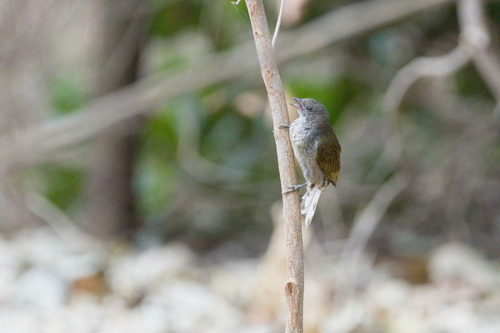 Lesser HoneyguideIndicator minorThe lesser honeyguide is a species of bird in the family Indicatoridae that is widely distributed across sub-Saharan Africa.
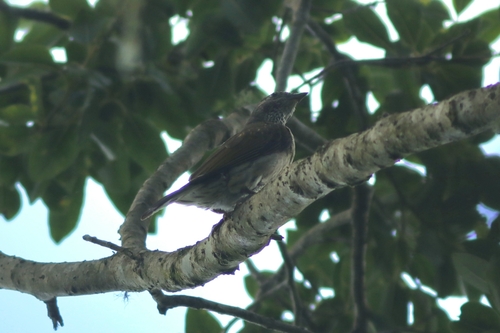 Scaly-throated HoneyguideIndicator variegatusMature scaly-throated honeyguides range between 18 and 19 centimetres (7.1 and 7.5 in) and typically weigh around 34 to 55 grams (0.075 to 0.121 lb), occasionally reaching up to 61 grams (0.134 lb).
 Yellow-rumped HoneyguideIndicator xanthonotusThe yellow-rumped honeyguide is sparrow sized and has a stout finch-like bill.
Side by side: Greater Honeyguide vs Scaly-throated Honeyguide
Learn the Greater Honeyguide in the BeakBrain App
Photo and call practice. Coming soon to iPhone and Android.
Play today's Daily BirdEvery photo and recording on this page is credited to its author under the licence shown. Spotted a problem with this page, or have a better photo? Contribute.