Learn what every symbol on the card means.Full credits and sources at beakbrain.com/symbols
 WoodlandSmall · 25 g


ID tip
The great xenops is 15 to 16 cm (5.9 to 6.3 in) long. It has a heavy, wedge-shaped, slightly upturned bill. The sexes' plumages are alike. Adults have a mostly light orange-rufous face with some blackish around the eye. Their forehead is pale but bright cinnamon-buff. Their crown and upperparts are unmarked bright rufous and their tail bright cinnamon-rufous. Their wing coverts are bright rufous, their primary coverts dull brownish, and their flight feathers bright orange-rufous with dark fuscous tips. Voice: The great xenops' song is a "long, very high, loud, nervous, unstructured series of chattering or liquid 'toc-toc-' and 'Wic-wic' notes, rising and falling with sudden crescendos".
Text from Wikipedia, licensed CC BY-SA 4.0.
When to see the Great Xenops
One bar for each month, and every month is filled: this bird is recorded here in all twelve. The wide bar is January, the month with the most records.
Where to see the Great Xenops
The map shades 1 country with regular records. Everything unshaded has no records. Countries are listed below the map.
About the Great Xenops
The great xenops is a species of bird in the Furnariinae subfamily of the ovenbird family Furnariidae. It is endemic to eastern Brazil.
Text adapted from Wikipedia, licensed CC BY-SA 4.0.
Easily confused with
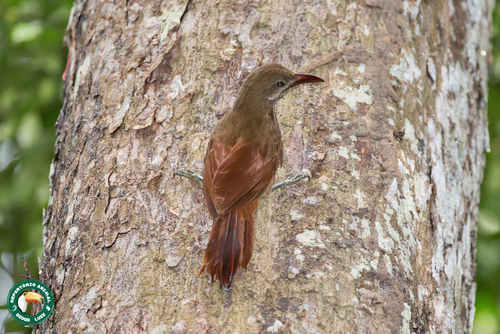 Red-billed WoodcreeperHylexetastes perrotiiThe red-billed woodcreeper is one of the largest members of its subfamily.
 Striated EarthcreeperGeocerthia serranaThe striated earchcreeper is 18 to 20.5 cm (7.1 to 8.1 in) long and weighs 41 to 52 g (1.4 to 1.8 oz).
 Itatiaia SpinetailAsthenes moreiraeThe Itatiaia spinetail is 18 to 19 cm (7.1 to 7.5 in) long and weighs 10 to 11 g (0.35 to 0.39 oz).
Learn the Great Xenops in the BeakBrain App
Photo and call practice. Coming soon to iPhone and Android.
Play today's Daily BirdEvery photo and recording on this page is credited to its author under the licence shown. Spotted a problem with this page, or have a better photo? Contribute.