Learn what every symbol on the card means.Full credits and sources at beakbrain.com/symbols
 UrbanCup nestMedium · 160 g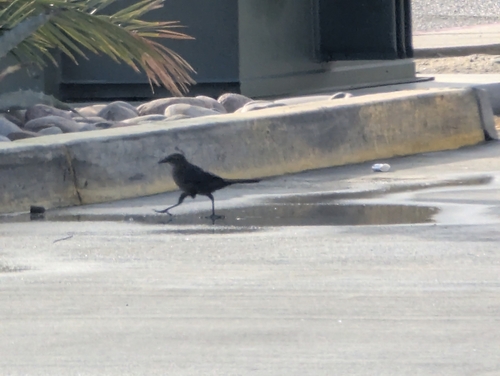


What the Great-tailed Grackle sounds like


ID tip
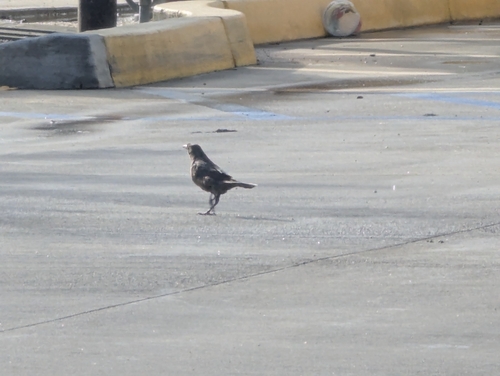
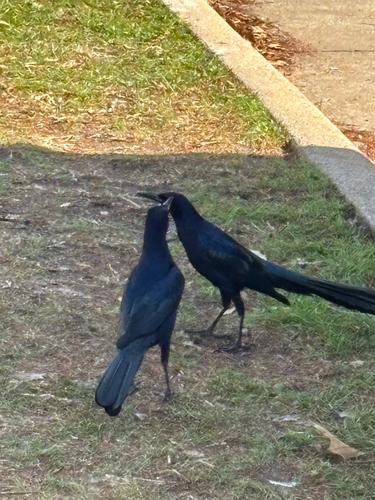
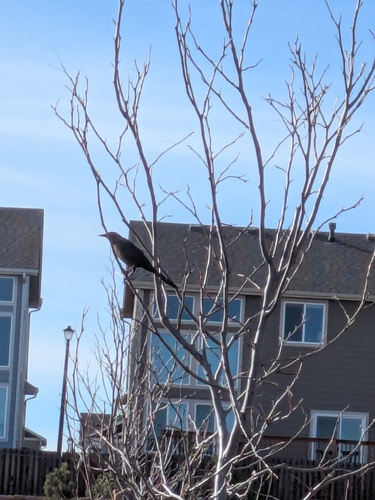
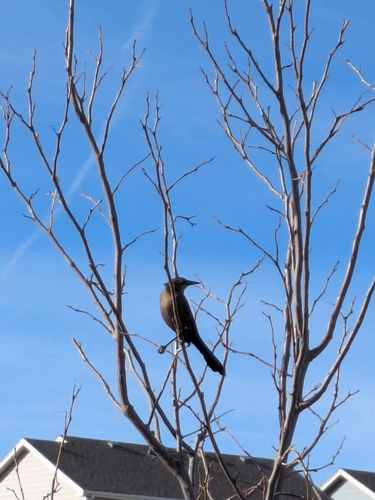
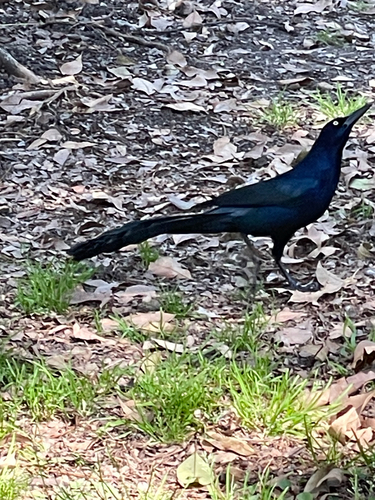
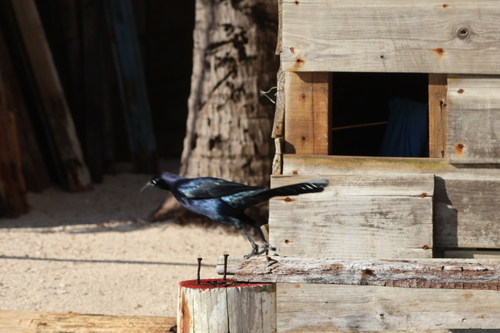
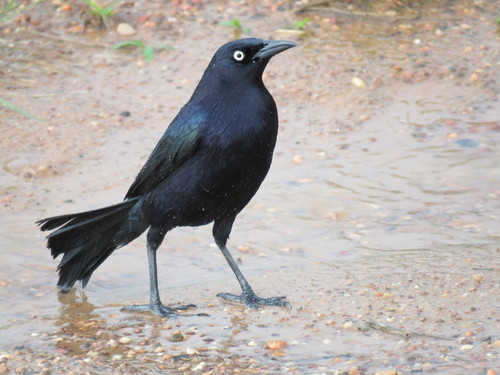
Great-tailed grackles are medium-sized birds (larger than starlings and smaller than crows; 38–46 cm (15–18 in) with males weighing 203–265 g (7.2–9.3 oz) and females 115–142 g (4.1–5.0 oz), and both sexes have long tails. Wingspan ranging 48–58 cm (19–23 in). Males are iridescent black with a purple-blue sheen on the feathers of the head and upper body, while females are brown with darker wings and tail. Adults of both sexes have bright yellow eyes, while juveniles of both sexes have brown eyes and brown plumage like females (except for streaks on the breast). Voice: Great-tailed grackles have an unusually large repertoire of vocalizations that are used year-round. The sounds range from "sweet, tinkling notes" to a "rusty gate hinge". Males use a wider variety of vocalization types, while females engage mostly in "chatter", however there is a report of a female performing the "territorial song".
Text from Wikipedia, licensed CC BY-SA 4.0.
When to see the Great-tailed Grackle
One bar for each month, and every month is filled: this bird is recorded here in all twelve. The wide bar is April, the month with the most records.
Where to see the Great-tailed Grackle
The map shades 22 countries with regular records, and 3 more in a lighter tone where the bird turns up only as a stray. Everything unshaded has no records. Countries are listed below the map.
Recorded as a rare visitor in Canada, Spain, United Kingdom.
About the Great-tailed Grackle
The great-tailed grackle or Mexican grackle is a medium-sized, highly social passerine bird native to North and South America. A member of the family Icteridae, it is one of 10 extant species of grackle and is closely related to the boat-tailed grackle and the extinct slender-billed grackle. In the southern and southwestern United States, the grackle is sometimes referred to simply as a "blackbird" or (erroneously) a "crow" due to its glossy black plumage; however, grackles form their own unique genus that is separate from other "blackbirds", such as the red-winged and Brewer's blackbirds, despite being in the same family (Icteridae).
Text adapted from Wikipedia, licensed CC BY-SA 4.0.
Easily confused with
 Boat-tailed GrackleQuiscalus majorThe male boat-tailed grackle is 37–43 cm (15–17 in) long and weighs 165–250 g (5.8–8.8 oz).
 Carib GrackleQuiscalus lugubrisMale Carib grackles average 26 cm (10 in) long and females about 22 cm (8.7 in).
 Greater Antillean GrackleQuiscalus nigerThe Greater Antillean grackle is 25 to 30 cm (9.8 to 12 in) long.
Side by side: Common Grackle vs Great-tailed Grackle · Boat-tailed Grackle vs Great-tailed Grackle · Carib Grackle vs Great-tailed Grackle · Great-tailed Grackle vs Greater Antillean Grackle
Learn the Great-tailed Grackle in the BeakBrain App
Photo and call practice. Coming soon to iPhone and Android.
Play today's Daily BirdEvery photo and recording on this page is credited to its author under the licence shown. Spotted a problem with this page, or have a better photo? Contribute.