Learn what every symbol on the card means.Full credits and sources at beakbrain.com/symbols
 ForestLarge · 939 g
When to see the Great Nicobar Serpent Eagle
One bar for each month. Filled bars are the 8 months with records; pale bars are months with none. The wide bar is March, the month with the most records.
About the Great Nicobar Serpent Eagle
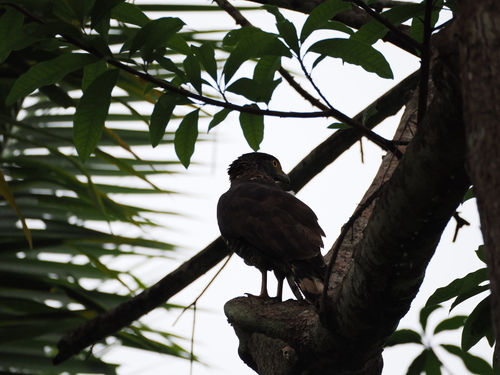
The Great Nicobar serpent eagle, also known as the South Nicobar serpent eagle, is a species of bird of prey in the family Accipitridae. It is probably the smallest known eagle, with a weight of about 450 g (0.99 lb), a wingspan of 85 to 95 cm and a body length of about 38 to 42 cm. It is endemic to forest on the Indian island of Great Nicobar. It is threatened by habitat loss.
Text adapted from Wikipedia, licensed CC BY-SA 4.0.
Easily confused with
 Mountain Serpent EagleSpilornis kinabaluensisThe mountain serpent eagle, also known as the Kinabalu serpent eagle, is a bird of prey that is found in northern Borneo.
 Sulawesi Serpent EagleSpilornis rufipectusThe Sulawesi serpent eagle is a species of bird of prey in the family Accipitridae.
 Andaman Serpent EagleSpilornis elginiThe call of the Andaman serpent eagle consists of three to four short chip-sounding whistles.
Learn the Great Nicobar Serpent Eagle in the BeakBrain App
Photo and call practice. Coming soon to iPhone and Android.
Play today's Daily BirdEvery photo and recording on this page is credited to its author under the licence shown. Spotted a problem with this page, or have a better photo? Contribute.