Learn what every symbol on the card means.Full credits and sources at beakbrain.com/symbols
 ForestCup nestMedium · 82 g


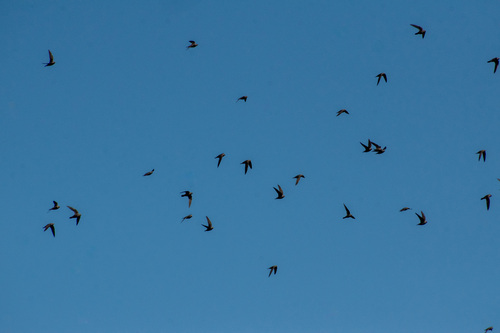
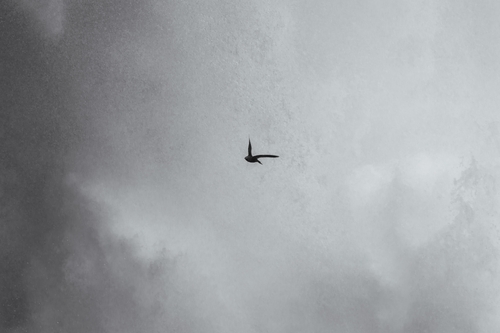
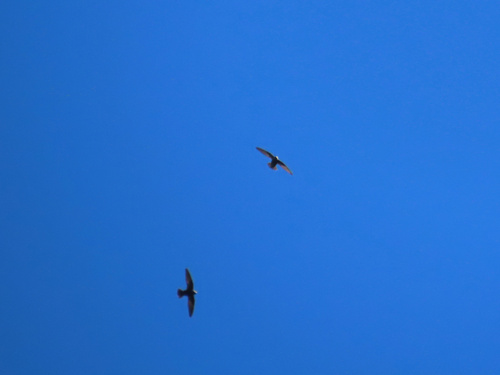
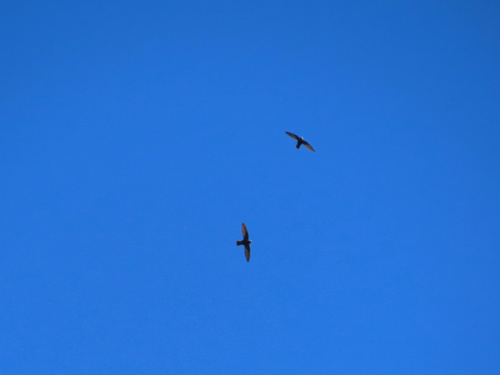

ID tip
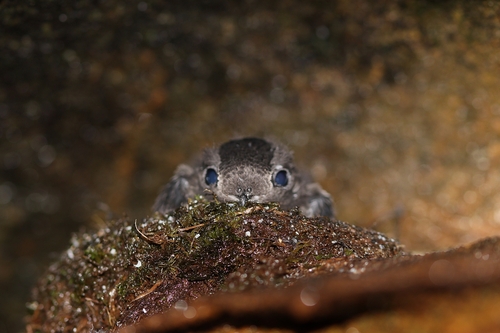
The great dusky swift is the largest member of genus Cypseloides. It is 18 cm (7.1 in) long and weighs 56 to 110 g (2.0 to 3.9 oz). The sexes have the same plumage. Adults have a chocolate brown crown and throat with pale gray edges to the feathers, giving a frosted appearance to the face. Their back is a darker brown, their rump a brown intermediate between the head and back, and their tail blackish brown. Their undersides are a paler brown than the back. The upper side of the wing is mostly brown and the underside somewhat lighter. Voice: The great dusky swift's principal vocalization is described as "a ti-ti-ti sound followed by a buzz, tirr-tshaarr."
Text from Wikipedia, licensed CC BY-SA 4.0.
When to see the Great Dusky Swift
One bar for each month. Filled bars are the 8 months with records; pale bars are months with none. The wide bar is October, the month with the most records.
Where to see the Great Dusky Swift
The map shades 4 countries with regular records. Everything unshaded has no records. Countries are listed below the map.
About the Great Dusky Swift
The great dusky swift is a species of bird in subfamily Cypseloidinae of the swift family Apodidae. It is found in Argentina, Brazil, Paraguay, and possibly Bolivia.
Text adapted from Wikipedia, licensed CC BY-SA 4.0.
Easily confused with
 Spot-fronted SwiftCypseloides cherrieiThe spot-fronted swift is about 14 cm (5.5 in) long and weighs about 23 g (0.81 oz).
 White-chinned SwiftCypseloides cryptusThe white-chinned swift is about 15 cm (5.9 in) long and weighs about 35 g (1.2 oz).
 Sooty SwiftCypseloides fumigatusThe sooty swift is about 15 cm (5.9 in) long.
Side by side: American Black Swift vs Great Dusky Swift
Learn the Great Dusky Swift in the BeakBrain App
Photo and call practice. Coming soon to iPhone and Android.
Play today's Daily BirdEvery photo and recording on this page is credited to its author under the licence shown. Spotted a problem with this page, or have a better photo? Contribute.