Learn what every symbol on the card means.Full credits and sources at beakbrain.com/symbols
 ForestCavity nestMedium · 275 g




ID tip
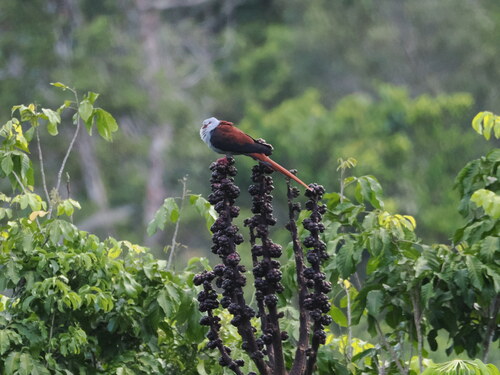
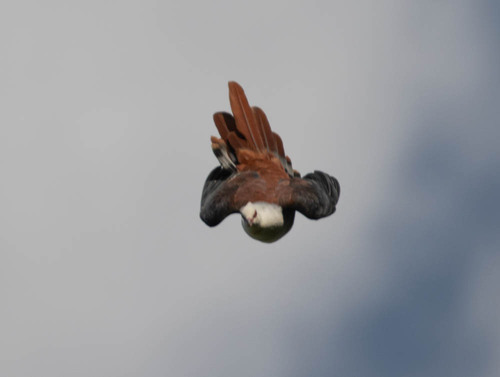
The great cuckoo-dove is a large and long-tailed pigeon, with a length of 47.5–52.5 cm (18.7–20.7 in) and a weight of 208–305 g (7.3–10.8 oz). A slight crest on the back of the head gives it a "big-headed" appearance. Birds of the nominate subspecies have the head, neck, and breast blue-grey or cream-white with a pale bluish-grey tinge, turning purplish grey on the back of the neck and upper back. The throat and belly are white, with the latter frequently having a pinkish tinge. The mantle, back, rump, and uppertail-coverts are chestnut-brown. Voice: The great cuckoo-dove has two distinct calls. The first call is a repeated, upslurred "cookuwook cookuwook cookuwook" resembling the call of the brown cuckoo-dove, but slower and more trisyllabic. The second call is a series of around 12 deep hoo notes, with the notes getting deeper and faster towards the end; this call has been described as resembling "insane laughter".
Text from Wikipedia, licensed CC BY-SA 4.0.
When to see the Great Cuckoo-Dove
One bar for each month. Filled bars are the 6 months with records; pale bars are months with none. The wide bar is July, the month with the most records.
Where to see the Great Cuckoo-Dove
The map shades 2 countries with regular records. Everything unshaded has no records. Countries are listed below the map.
About the Great Cuckoo-Dove
The great cuckoo-dove is a species of bird in the pigeon family, Columbidae. First described by the Dutch zoologist Coenraad Jacob Temminck in 1824, it is found on New Guinea, several surrounding islands, and Wallacea, where it mainly inhabits primary forest and the forest edge. It is a large, distinctive pigeon, with a length of 47.5–52.5 cm (18.7–20.7 in) and a weight of 208–305 g (7.3–10.8 oz). In adults, the head, neck, and breast are whitish or blue-grey, the underparts are pale bluish-grey, the upperparts are chestnut-brown, and the outer wings are black. Females differ from males in having more yellowish irises and duller orbital skin.
Text adapted from Wikipedia, licensed CC BY-SA 4.0.
Easily confused with
 Pied Cuckoo-DoveReinwardtoena browniThe pied cuckoo-dove is a large and long-tailed pigeon, with a length of 40–46 cm (16–18 in) and a weight of 279–325 g (9.8–11.5 oz).
Crested Cuckoo-DoveReinwardtoena crassirostrisThe crested cuckoo-dove is a large and robust pigeon, with a length of 40–42 cm (16–17 in).
Pied Cuckoo-DoveReinwardtoena browniThe pied cuckoo-dove is a large and long-tailed pigeon, with a length of 40–46 cm (16–18 in) and a weight of 279–325 g (9.8–11.5 oz).
Crested Cuckoo-DoveReinwardtoena crassirostrisThe crested cuckoo-dove is a large and robust pigeon, with a length of 40–42 cm (16–17 in).
Learn the Great Cuckoo-Dove in the BeakBrain App
Photo and call practice. Coming soon to iPhone and Android.
Play today's Daily BirdEvery photo and recording on this page is credited to its author under the licence shown. Spotted a problem with this page, or have a better photo? Contribute.