Learn what every symbol on the card means.Full credits and sources at beakbrain.com/symbols
 ForestPlatform nestLarge · 965 g




What the Great Blue Turaco sounds like

ID tip
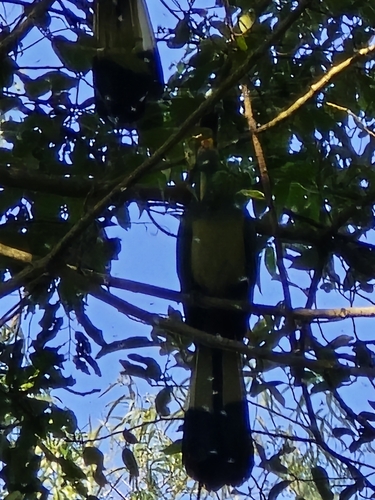
Generally, the great blue turaco is 70–76 cm (28–30 in) in length with a mass of 800–1,231 g (1.764–2.714 lb). The adult great blue turaco has predominantly grey-blue upperparts with an upright blue-black crest, white chin, yellow-green lower breast and yellow belly darkening to chestnut brown posteriorly. The undertail coverts are chestnut, and the undertail is black and yellowish. The yellow bill has an orange-red tip, the eyes are brown, and surrounded by a ring of black bare skin. The legs and feet are black with yellow soles. The sexes have similar plumage.
Text from Wikipedia, licensed CC BY-SA 4.0.
When to see the Great Blue Turaco
One bar for each month, and every month is filled: this bird is recorded here in all twelve. The wide bar is July, the month with the most records.
Where to see the Great Blue Turaco
The map shades 19 countries with regular records. Everything unshaded has no records. Countries are listed below the map.
About the Great Blue Turaco
The great blue turaco is a bird species of the family Musophagidae. At 70–76 cm (28–30 in) in length, it is the largest species of turaco. It has predominantly grey-blue plumage with an upright blue-black crest around 10 cm (3.9 in) high. The male and female have similar plumage. It is widespread throughout the African tropical rainforest.
Text adapted from Wikipedia, licensed CC BY-SA 4.0.
Easily confused with
 Eastern Plantain-eaterCrinifer zonurusThe eastern plantain-eater also known as the eastern grey plantain-eater, is a large member of the turaco family, a group of large arboreal near-passerine birds restricted to Africa.
 Bare-faced Go-away-birdCrinifer personatusThe sexes are similar, other than the female's green beak.
 White-bellied Go-away-birdCrinifer leucogasterThis species averages 51 cm (20") in length.
Side by side: Great Blue Turaco vs White-bellied Go-away-bird · Bare-faced Go-away-bird vs Great Blue Turaco
Learn the Great Blue Turaco in the BeakBrain App
Photo and call practice. Coming soon to iPhone and Android.
Play today's Daily BirdEvery photo and recording on this page is credited to its author under the licence shown. Spotted a problem with this page, or have a better photo? Contribute.