Learn what every symbol on the card means.Full credits and sources at beakbrain.com/symbols
 WetlandCup nestSmall · 25 g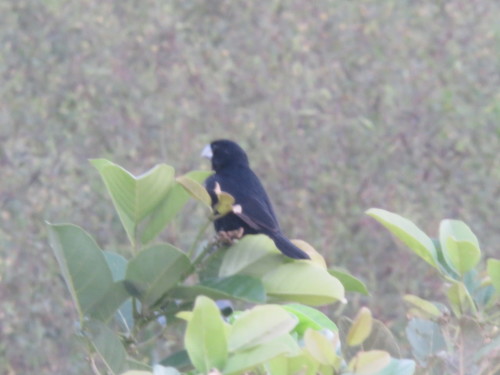

ID tip
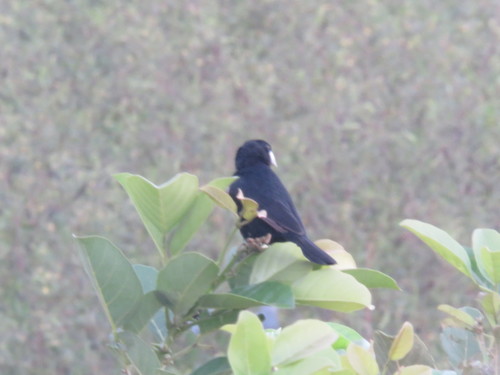
The great-billed seed finch is sexually dimorphic. They have an extremely large and thick bill, that is chalky white in males and black in females. The beak volume is about 840mm³. The males are black with white or white and black under wing-coverts. The females have a warm brown back and a buffy brown belly with white under wing-coverts. The females are very similar to other adult females of the Sporophila genus. Both the male and female great-billed seed finch are very similar in appearance to the male and female large-billed seed finch. It is a medium-sized finch at around 14.5–16.5 cm (5.
Text from Wikipedia, licensed CC BY-SA 4.0.
When to see the Great-billed Seed Finch
One bar for each month. Filled bars are the 5 months with records; pale bars are months with none. The wide bar is January, the month with the most records.
About the Great-billed Seed Finch
The great-billed seed finch is a species of bird in the family Thraupidae. Its natural habitats are subtropical or tropical moist shrubland, swamps, and heavily degraded former forest. They are found in two separate general populations, one in the northern Amazon rainforest and the other in the Cerrado. They live in flooded areas with nests low to the ground. The adults express strong sexual dimorphism. Males are black with white under wing-coverts and ivory white bills, and the females are generally light brown with white under wing-coverts and black bills. Both the male and female have very large, thick bills.
Text adapted from Wikipedia, licensed CC BY-SA 4.0.
Easily confused with
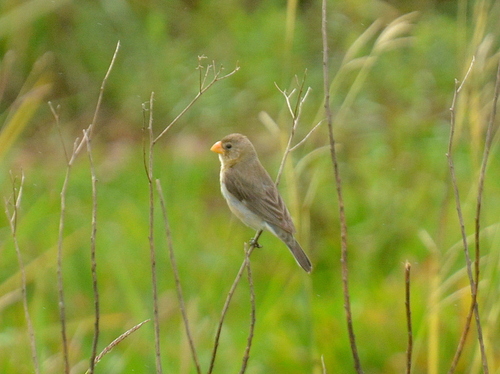 Tropeiro SeedeaterSporophila beltoniThe adult male is distinguished from the plumbeous seedeater by its larger size and bluish (rather than plumbeous) grey plumage, and from that and other Sporophila seedeaters, by having a robust, bright yellow beak with an arched culmen, and by vocalisations that include unique call notes.
 Large-billed Seed FinchSporophila crassirostrisThe large-billed seed finch is a species of bird in the family Thraupidae.
Learn the Great-billed Seed Finch in the BeakBrain App
Photo and call practice. Coming soon to iPhone and Android.
Play today's Daily BirdEvery photo and recording on this page is credited to its author under the licence shown. Spotted a problem with this page, or have a better photo? Contribute.