Learn what every symbol on the card means.Full credits and sources at beakbrain.com/symbols
 ForestCup nestTiny · 6 g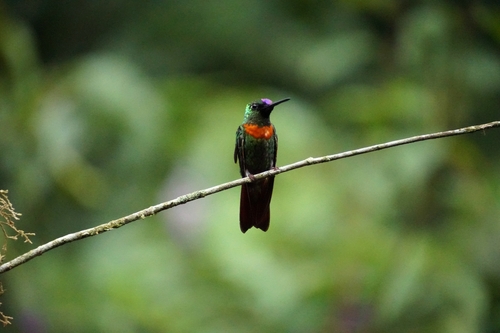
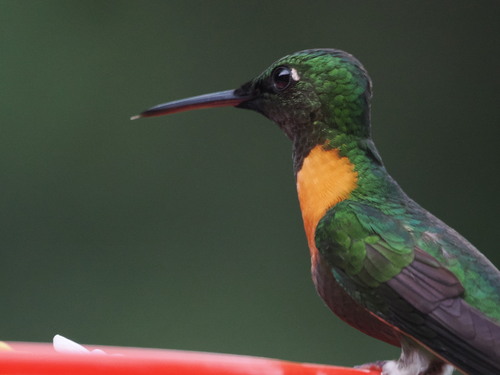
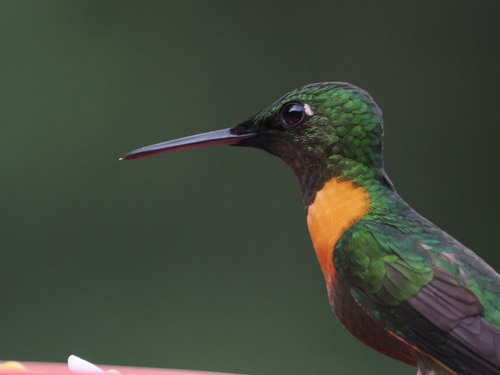
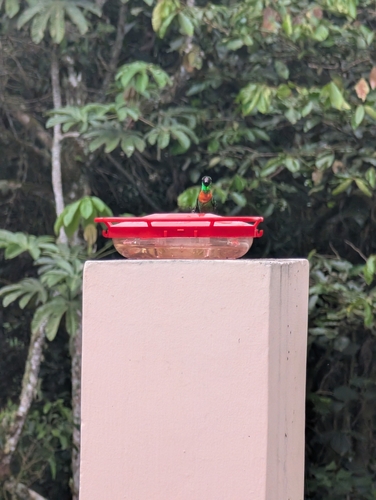
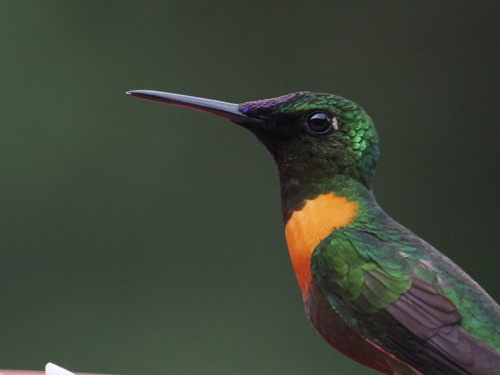
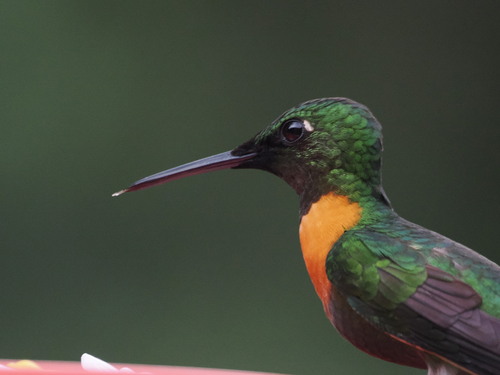
ID tip
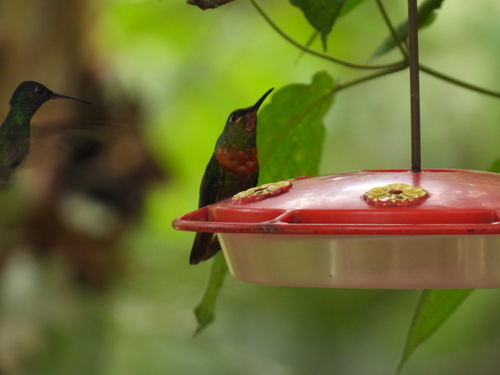
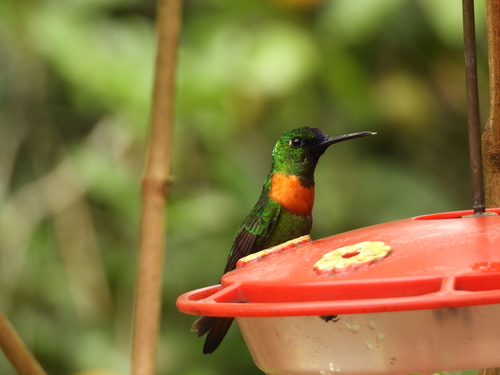
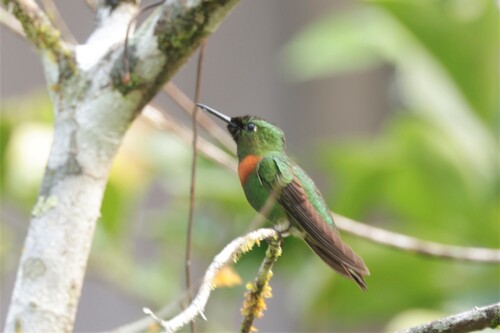
H.aurescens ranges in size from 11 to 12 cm, with an average weight of about 6.2 g. This is a sexually dimorphic species with minor differences in plumage and bill lengths between sexes. Both sexes have a narrow frontlet of glittering purplish-blue which is underdeveloped in immature individuals. The bill, black to dark coloured is "unspecialised" being relatively short and straight; while the irises are brown and tarsus black. The tail is forked with the central pair of feathers bronze-green while the other tail feathers have chestnut edges and bronze-green tips.
Text from Wikipedia, licensed CC BY-SA 4.0.
When to see the Gould's Jewelfront
One bar for each month, and every month is filled: this bird is recorded here in all twelve. The wide bar is October, the month with the most records.
Where to see the Gould's Jewelfront
The map shades 5 countries with regular records, and 1 more in a lighter tone where the bird turns up only as a stray. Everything unshaded has no records. Countries are listed below the map.
Recorded as a rare visitor in Venezuela.
About the Gould's Jewelfront
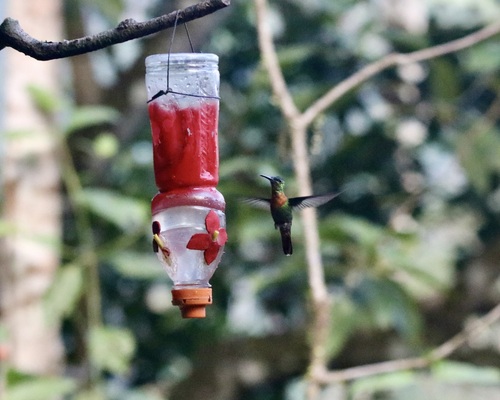
Gould's jewelfront or Gould's brilliant is a medium-sized hummingbird in the family Trochilidae. It is found in tropical and equatorial South America. This is an uncommon species with an unusually large range compared to the other members of Heliodoxa.
Text adapted from Wikipedia, licensed CC BY-SA 4.0.
Easily confused with
 Black-throated BrilliantHeliodoxa schreibersiiThe nominate subspecies H. s. schreibersii of black-throated brilliant is 11.5 to 13 cm (4.5 to 5.1 in) long.
 Brazilian RubyHeliodoxa rubricaudaThe Brazilian ruby is 10.8 to 11.3 cm (4.3 to 4.4 in) long.
 Velvet-browed BrilliantHeliodoxa xanthogonysThe velvet-browed brilliant is 10 to 11 cm (3.9 to 4.3 in) long including its approximately 2 cm (0.8 in) bill, and weighs 5.5 to 7.5 g (0.19 to 0.26 oz).
Side by side: Empress Brilliant vs Gould's Jewelfront · Gould's Jewelfront vs Violet-fronted Brilliant · Brazilian Ruby vs Gould's Jewelfront · Black-throated Brilliant vs Gould's Jewelfront
Learn the Gould's Jewelfront in the BeakBrain App
Photo and call practice. Coming soon to iPhone and Android.
Play today's Daily BirdEvery photo and recording on this page is credited to its author under the licence shown. Spotted a problem with this page, or have a better photo? Contribute.