Learn what every symbol on the card means.Full credits and sources at beakbrain.com/symbols
 ForestPlatform nestLarge · 555 g


ID tip
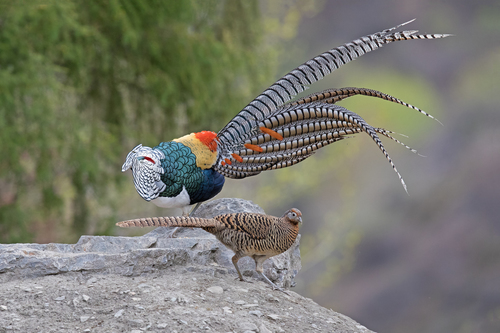
The adult male is approximately 100 cm (39 in) in length, with its tail accounting for two-thirds of the total length, and around 500–700 g (1–2 lb) in weight. Its coloration is characterized by a golden crest and rump and by a bright red body. It possesses an orange ruff or "cape" on the back that can be spread in display, appearing as an alternating black and orange fan that covers all of the face except for the eyes. The eye is bright yellow, with a pinpoint black pupil. The face, throat, chin, and the sides of neck are rusty tan. The wattles and orbital skin are both yellow.
Text from Wikipedia, licensed CC BY-SA 4.0.
When to see the Golden Pheasant
One bar for each month. Filled bars are the 8 months with records; pale bars are months with none. The wide bar is May, the month with the most records.
Where to see the Golden Pheasant
The map shades 3 countries with regular records, and 15 more in a lighter tone where the bird turns up only as a stray. Everything unshaded has no records. Countries are listed below the map.
Recorded as a rare visitor in United States, France, Germany, Canada, Belgium, Sweden, Norway, Taiwan, Australia, Italy, Spain, Austria, Netherlands, Portugal, Ireland.
About the Golden Pheasant
The golden pheasant, also known as the Chinese pheasant, and rainbow pheasant, is a gamebird of the order Galliformes and the family Phasianidae (pheasants). The genus name is from Ancient Greek khrusolophos, "with golden crest", and pictus is Latin for "painted" from pingere, "to paint".
Text adapted from Wikipedia, licensed CC BY-SA 4.0.
Easily confused with
Learn the Golden Pheasant in the BeakBrain App
Photo and call practice. Coming soon to iPhone and Android.
Play today's Daily BirdEvery photo and recording on this page is credited to its author under the licence shown. Spotted a problem with this page, or have a better photo? Contribute.