Learn what every symbol on the card means.Full credits and sources at beakbrain.com/symbols
 ForestCup nestTiny · 9 g


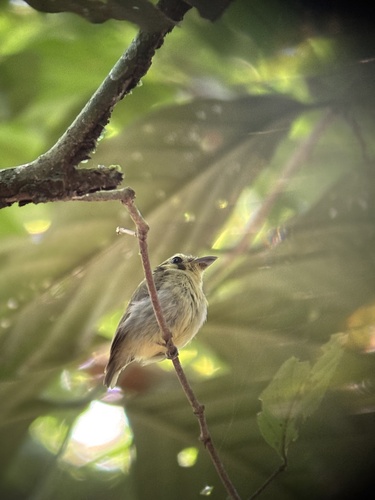
What the Golden-crowned Spadebill sounds like


ID tip
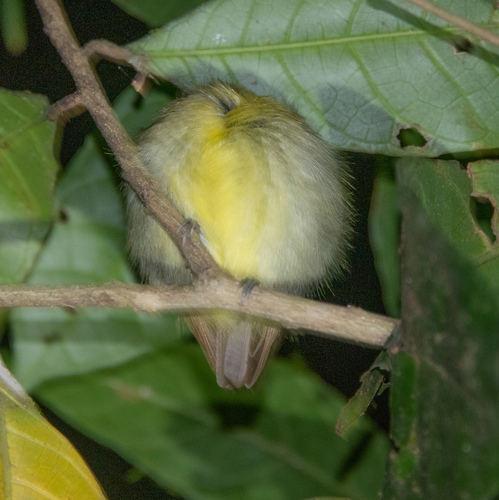
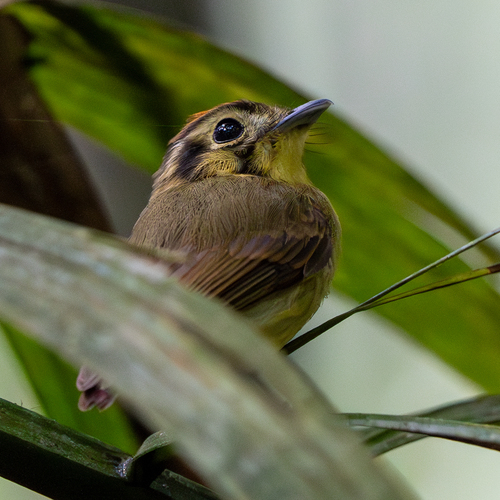
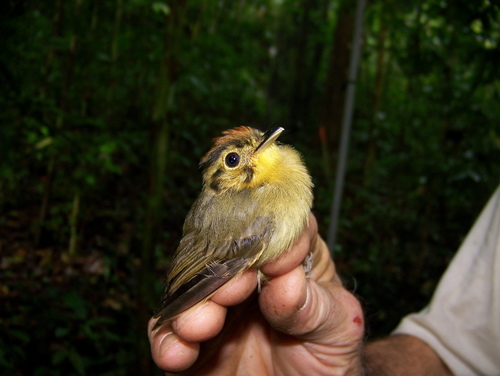
The golden-crowned spadebill is the smallest member of its genus. It is about 8.5 to 9 cm (3.3 to 3.5 in) long and weighs 8 to 9 g (0.28 to 0.32 oz). It has a large head with a bold facial pattern and a stubby tail. The sexes have almost the same plumage. Males of the nominate subspecies have a black crown with a partially hidden orange-rufous patch in the center; females have a purer orange patch. Both sexes have pale buff-yellow as a patch above the lores, as an eye-ring, as a stripe behind the eye, and as a patch on the ear coverts. Voice: The golden-crowned spadebill's song has been described as "a very high-pitched, rapid, hissing trill that undulates slightly...and could easily be mistaken for an insect noise". A similar description is "a weak, insectlike, and high-pitched trill, se'e'e'e'e'e'e'r'r'r'r'e'e'ep...barely audible at any distance and easily overlooked".
Text from Wikipedia, licensed CC BY-SA 4.0.
When to see the Golden-crowned Spadebill
One bar for each month, and every month is filled: this bird is recorded here in all twelve. The wide bar is March, the month with the most records.
Where to see the Golden-crowned Spadebill
The map shades 13 countries with regular records. Everything unshaded has no records. Countries are listed below the map.
About the Golden-crowned Spadebill
The golden-crowned spadebill is a species of bird in the family Tyrannidae, the tyrant flycatchers. It is found Central America from Honduras to Panama and in every mainland South American country except Argentina, Chile, Paraguay, and Uruguay.
Text adapted from Wikipedia, licensed CC BY-SA 4.0.
Easily confused with
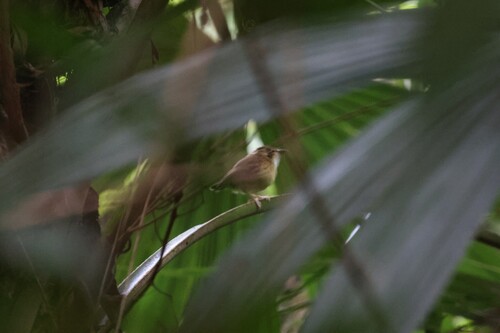 Stub-tailed SpadebillPlatyrinchus cancrominusThe stub-tailed spadebill can grow up to 9.5 cm (3.74 in) long and weigh up to 12 g (0.42 oz).
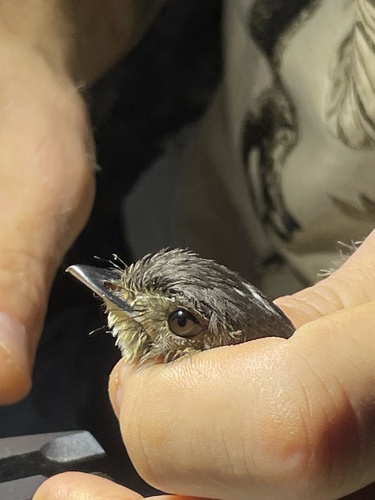 White-crested SpadebillPlatyrinchus platyrhynchosThe white-crested spadebill is 10.5 to 12 cm (4.1 to 4.7 in) long and weighs 11.5 to 13 g (0.41 to 0.46 oz).
 Russet-winged SpadebillPlatyrinchus leucoryphusThe russet-winged spadebill is the largest member of its genus.
Side by side: Golden-crowned Spadebill vs White-throated Spadebill · Golden-crowned Spadebill vs Stub-tailed Spadebill · Golden-crowned Spadebill vs Streamer-tailed Tyrant
Learn the Golden-crowned Spadebill in the BeakBrain App
Photo and call practice. Coming soon to iPhone and Android.
Play today's Daily BirdEvery photo and recording on this page is credited to its author under the licence shown. Spotted a problem with this page, or have a better photo? Contribute.