Learn what every symbol on the card means.Full credits and sources at beakbrain.com/symbols
 WoodlandCavity nestMedium · 245 g




ID tip
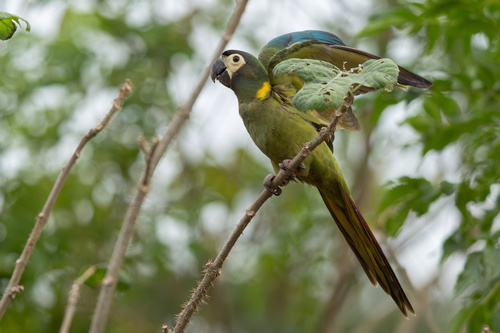
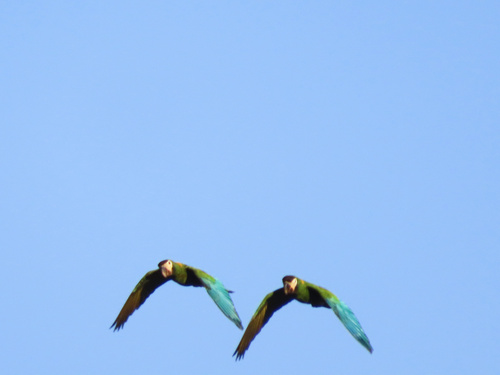
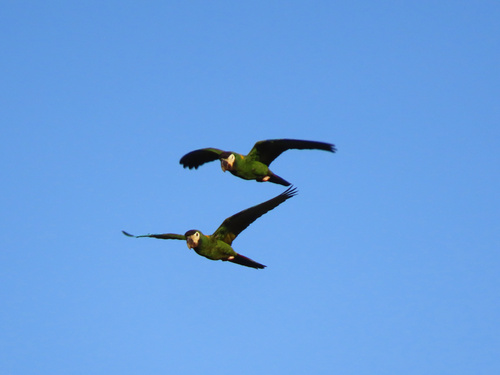
It has a total length of about 38 cm (15 in), of which almost half is tail feathers. The general plumage is green, with a distinct yellow collar that is broadest on the back of the neck. The yellow collar develops as the bird ages, with more vibrant colors found in mature birds. The front and crown is brownish black. The remiges and primary coverts are blue and the long, pointed tail has a red base, a narrow green center and a blue tip. The underside of the tail and flight feathers are greenish-yellow, similar to that of several other small macaws such as the blue-winged and red-bellied macaw.
Text from Wikipedia, licensed CC BY-SA 4.0.
When to see the Golden-collared Macaw
One bar for each month. Filled bars are the 9 months with records; pale bars are months with none. The wide bar is October, the month with the most records.
Where to see the Golden-collared Macaw
The map shades 4 countries with regular records. Everything unshaded has no records. Countries are listed below the map.
About the Golden-collared Macaw
The golden-collared macaw or yellow-collared macaw is a small, mostly green Central South American parrot, a member of a large group of Neotropical parrots known as macaws. It has a bright yellow patch on the back of its neck/upper shoulders that gives the species its name. In aviculture, it is one of a number of smaller macaws often called "mini-macaws".
Text adapted from Wikipedia, licensed CC BY-SA 4.0.
Easily confused with
 Blue-headed MacawPrimolius couloniThe blue-headed macaw is 41 cm (16 in) long.
 Blue-winged MacawPrimolius maracanaIt has a total length of approximately 36–43 cm (14–17 in).
Side by side: Blue-winged Macaw vs Golden-collared Macaw · Blue-headed Macaw vs Golden-collared Macaw
Learn the Golden-collared Macaw in the BeakBrain App
Photo and call practice. Coming soon to iPhone and Android.
Play today's Daily BirdEvery photo and recording on this page is credited to its author under the licence shown. Spotted a problem with this page, or have a better photo? Contribute.