Learn what every symbol on the card means.Full credits and sources at beakbrain.com/symbols
 GrasslandScrapeLarge · 312 g

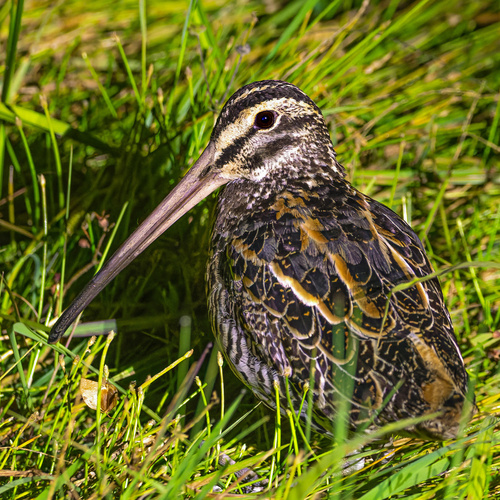
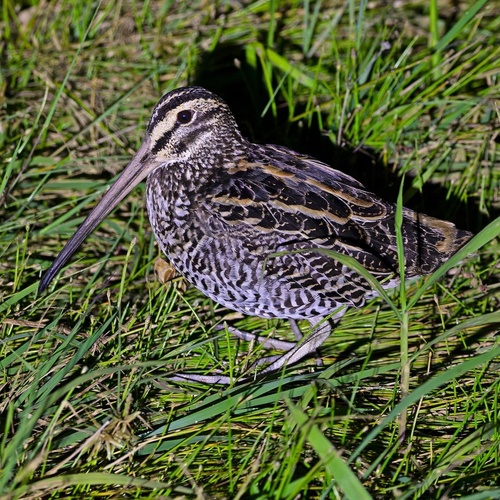
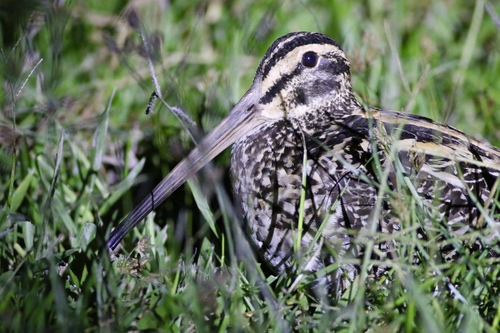

ID tip
This is the largest snipe at 36 to 47 cm (14 to 19 in) in length. G. u. gigantea, as its name suggests, is larger than the nominate subspecies with little overlap in size; for example, its bill length is usually more than 12 cm (4.7 in), whereas G. u. undulata is usually less than 11.5 cm (4.5 in) and total length is up to about 43.5 cm (17.1 in). Body mass in the nominate subspecies is from 270 to 362 g (9.5 to 12.8 oz), averaging 294 g (10.4 oz) in males and 332 g (11.7 oz), while in G. u. gigantea, body mass is known to range from 420 to 500 g (15 to 18 oz).
Text from Wikipedia, licensed CC BY-SA 4.0.
When to see the Giant Snipe
One bar for each month. Filled bars are the 11 months with records; pale bars are months with none. The wide bar is October, the month with the most records.
Where to see the Giant Snipe
The map shades 7 countries with regular records. Everything unshaded has no records. Countries are listed below the map.
About the Giant Snipe
The giant snipe is a stocky wader. It breeds in South America. The nominate subspecies G. u. undulata occurs in two distinct areas, one in Colombia, and the other from Venezuela through Guyana, Suriname and French Guiana to extreme north-eastern Brazil. The southern subspecies G. u. gigantea is found in eastern Bolivia, eastern Paraguay and south-east Brazil, and probably also in Uruguay and north-eastern Argentina.
Text adapted from Wikipedia, licensed CC BY-SA 4.0.
Easily confused with
 Solitary SnipeGallinago solitariaThe solitary snipe is a heavy snipe 29–31 cm long with a stocky body and relatively short legs for a wader.
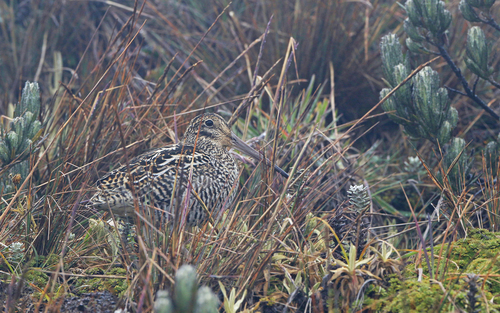 Jameson's SnipeGallinago jamesoniThis 30–32 cm long snipe has a stocky body and relatively short legs for a wader.
 Puna SnipeGallinago andinaThe puna snipe is 22.5 to 25 cm (8.9 to 9.8 in) long and weighs 65 to 105 g (2.3 to 3.7 oz).
Learn the Giant Snipe in the BeakBrain App
Photo and call practice. Coming soon to iPhone and Android.
Play today's Daily BirdEvery photo and recording on this page is credited to its author under the licence shown. Spotted a problem with this page, or have a better photo? Contribute.