Learn what every symbol on the card means.Full credits and sources at beakbrain.com/symbols
 ShrublandCup nestSmall · 20 g


ID tip
Its mass is in the range of 17–31 g (0.60–1.09 oz), making it approximately twice as heavy as the next largest hummingbird. It has a wingspan of 21.5 cm (8.5 in), with a body length of 23 cm (9.1 in). The two subspecies are visually distinguishable. P. g. peruviana is yellowish brown overall and has white on the chin and throat, where P. g. gigas is more olive green to brown and lacks white on the chin and throat.
Text from Wikipedia, licensed CC BY-SA 4.0.
When to see the Giant Hummingbird
One bar for each month. Filled bars are the 11 months with records; pale bars are months with none. The wide bar is October, the month with the most records.
Where to see the Giant Hummingbird
The map shades 5 countries with regular records, and 1 more in a lighter tone where the bird turns up only as a stray. Everything unshaded has no records. Countries are listed below the map.
Recorded as a rare visitor in Colombia.
About the Giant Hummingbird
The southern giant hummingbird is one of two species in the genus Patagona and the second largest hummingbird species, after its close relative the northern giant hummingbird.
Text adapted from Wikipedia, licensed CC BY-SA 4.0.
Easily confused with
 Blue-vented HummingbirdSaucerottia hoffmanniThe blue-vented hummingbird is 8 to 11 cm (3.1 to 4.3 in) long and weighs an average of 4.45 g (0.16 oz).
 Blue-chested HummingbirdPolyerata amabilisThe blue-chested hummingbird is a species of hummingbird in the family Trochilidae.
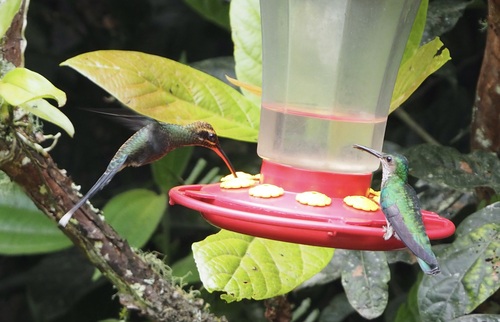 White-whiskered HermitPhaethornis yaruquiThe white-whiskered hermit is about 13 cm (5.1 in) long.
Side by side: Blue-vented Hummingbird vs Giant Hummingbird · Giant Hummingbird vs White-whiskered Hermit · Amazilia Hummingbird vs Giant Hummingbird
Watch the Giant Hummingbird on live cams
Browse all 118 bird cams worldwide, live and seasonal, by region and species.
Learn the Giant Hummingbird in the BeakBrain App
Photo and call practice. Coming soon to iPhone and Android.
Play today's Daily BirdEvery photo and recording on this page is credited to its author under the licence shown. Spotted a problem with this page, or have a better photo? Contribute.