Learn what every symbol on the card means.Full credits and sources at beakbrain.com/symbols
 WetlandPlatform nestHuge · 2.4 kg


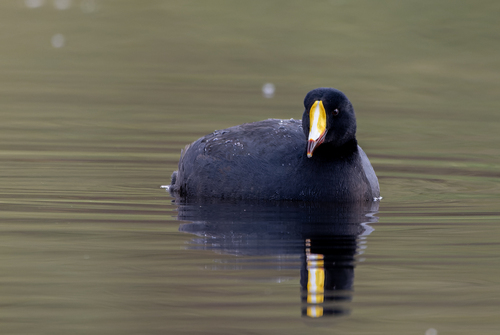
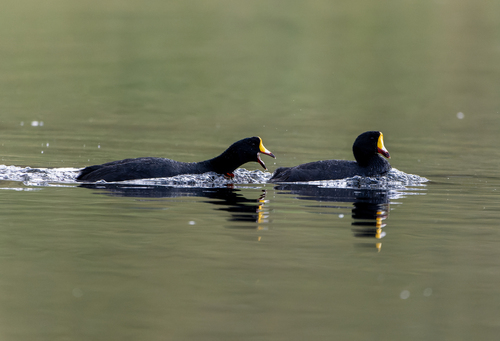
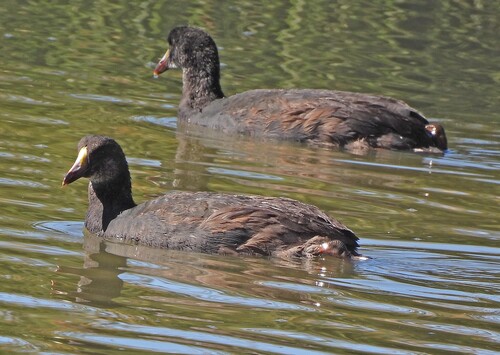
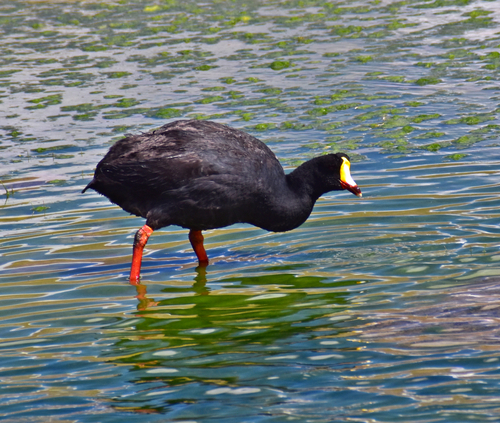
ID tip
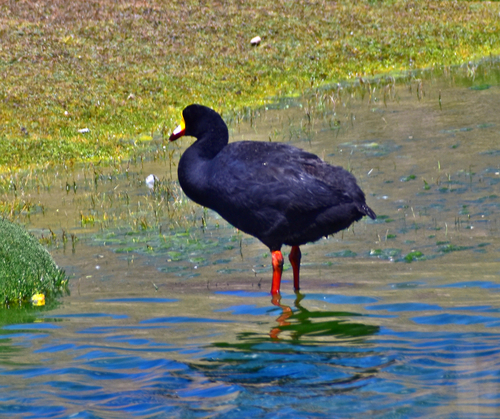
The giant coot is the second largest extant member of family Rallidae, after the takahē of New Zealand. Adults are 48 to 59 cm (19 to 23 in) long. They weigh about 2,000 to 2,500 g (4.4 to 5.5 lb) and are too heavy to fly, though immature birds are smaller and readily fly. The sexes are alike. Adults have a bulky body and a disproportionately small head. Their plumage is deep slaty gray that is blacker on the head and neck. Their undertail coverts have some white streaking. Voice: Male giant coots make "alternating gobbling or laughing 'houehouhouhouhoou' and low, growling 'hrr' or 'horr' sounds". Females make "low, crackling 'chee-jrrrh' low squeaking or cracking sounds"; when with a male they also make a "soft 'hi-hirr hirrr hirrr...'".
Text from Wikipedia, licensed CC BY-SA 4.0.
When to see the Giant Coot
One bar for each month, and every month is filled: this bird is recorded here in all twelve. The wide bar is October, the month with the most records.
Where to see the Giant Coot
The map shades 4 countries with regular records. Everything unshaded has no records. Countries are listed below the map.
About the Giant Coot
The giant coot is a species of bird in subfamily Rallinae of family Rallidae, the rails, gallinules, and coots. It is found in Argentina, Bolivia, Chile, and Peru.
Text adapted from Wikipedia, licensed CC BY-SA 4.0.
Easily confused with
 Horned CootFulica cornutaHorned coot males average a little larger than the female.
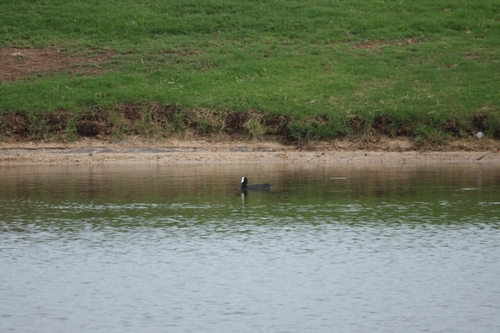 Hawaiian CootFulica alaiThe ʻAlae keʻokeʻo, also known as the Hawaiian coot in English, is a bird in the rail family, Rallidae, that is endemic to Hawaii.
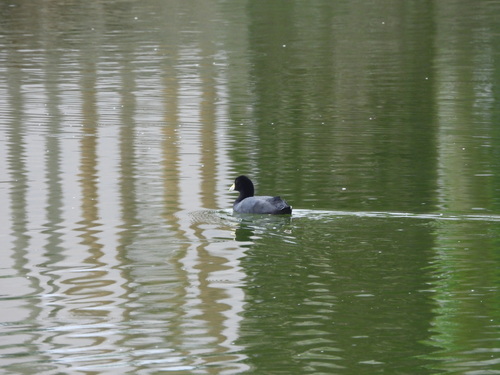 Andean CootFulica ardesiacaThe Andean coot is 40 to 43 cm (16 to 17 in) long.
Side by side: Andean Coot vs Giant Coot
Learn the Giant Coot in the BeakBrain App
Photo and call practice. Coming soon to iPhone and Android.
Play today's Daily BirdEvery photo and recording on this page is credited to its author under the licence shown. Spotted a problem with this page, or have a better photo? Contribute.