Learn what every symbol on the card means.Full credits and sources at beakbrain.com/symbols
 ShrublandDomed nestTiny · 9 g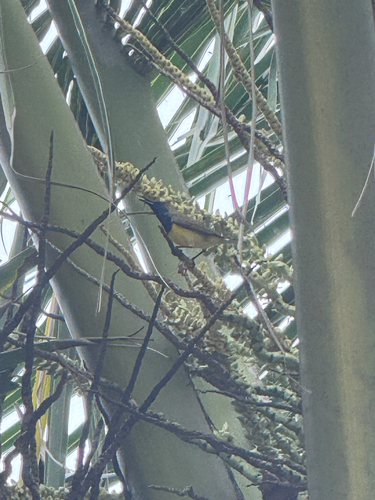


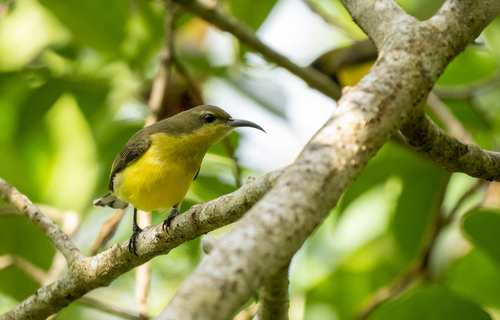
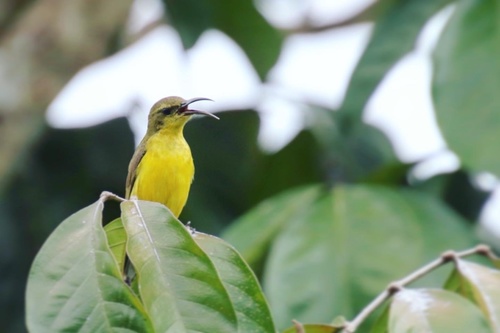
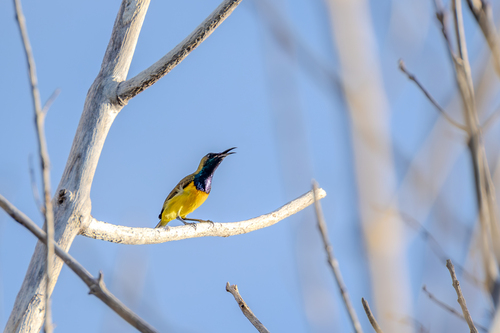
ID tip
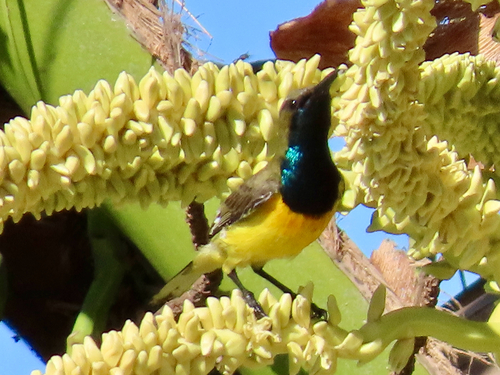
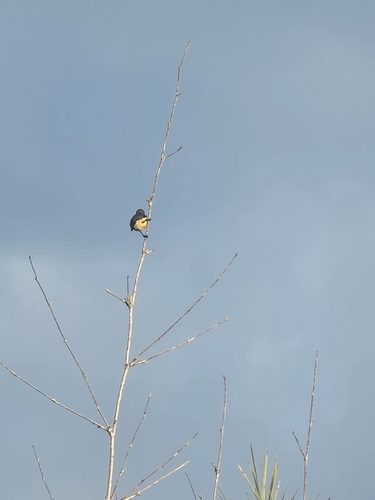
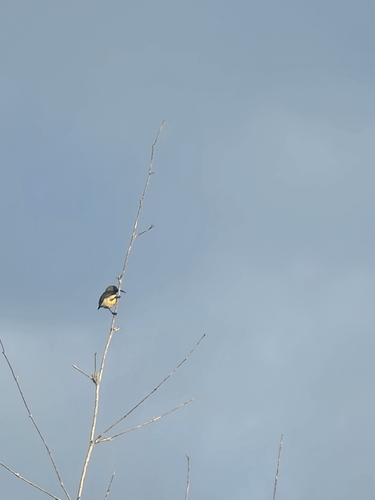
The garden sunbird is 10–11.4 cm (3.9–4.5 in) in size; males weigh 6.7–11.9 g (0.24–0.42 oz) and females 6–10 g (0.21–0.35 oz). The male in its nominate (jugularis) form displays an olive hue on its upper body, featuring black wing feathers with green edges and a black tail adorned with white tips. The areas around its eyes (lores), neck, chin, throat, and breast are dark and iridescent, accompanied by yellow pectoral tufts. The lower portion of the bird is dark yellow, sometimes with a brown band encircling the gorget area. The iris is dark brown, while its bill and legs are black.
Text from Wikipedia, licensed CC BY-SA 4.0.
When to see the Garden Sunbird
One bar for each month, and every month is filled: this bird is recorded here in all twelve. The wide bar is February, the month with the most records.
Where to see the Garden Sunbird
The map shades 8 countries with regular records, and 1 more in a lighter tone where the bird turns up only as a stray. Everything unshaded has no records. Countries are listed below the map.
Recorded as a rare visitor in Papua New Guinea.
About the Garden Sunbird
The garden sunbird, previously known as the olive-backed sunbird, is a species of passerine bird in the family Nectariniidae that is found in the Philippines except on the Palawan island group. It was formerly considered to be conspecific with seven other species: the ornate sunbird, Palawan sunbird, Sahul sunbird, Tukangbesi sunbird, Flores Sea sunbird, South Moluccan sunbird and the Mamberamo sunbird. It is a small, brightly coloured bird with olive-green plumage on the wings and back with a bright yellow chest. It has a long downward-curved bill it uses for taking nectar and capturing insects.
Text adapted from Wikipedia, licensed CC BY-SA 4.0.
Easily confused with
 Dusky SunbirdCinnyris fuscusThe dusky sunbird is a species of bird in the family Nectariniidae.
Dusky SunbirdCinnyris fuscusThe dusky sunbird is a species of bird in the family Nectariniidae.
Dusky SunbirdCinnyris fuscusThe dusky sunbird is a species of bird in the family Nectariniidae.
 Purple-banded SunbirdCinnyris bifasciatusThe purple-banded sunbird is a species of bird in the family Nectariniidae.
Side by side: Beautiful Sunbird vs Garden Sunbird · Garden Sunbird vs Orange-breasted Sunbird
Learn the Garden Sunbird in the BeakBrain App
Photo and call practice. Coming soon to iPhone and Android.
Play today's Daily BirdEvery photo and recording on this page is credited to its author under the licence shown. Spotted a problem with this page, or have a better photo? Contribute.