Learn what every symbol on the card means.Full credits and sources at beakbrain.com/symbols
 ShrublandCavity nestTiny · 15 g


ID tip
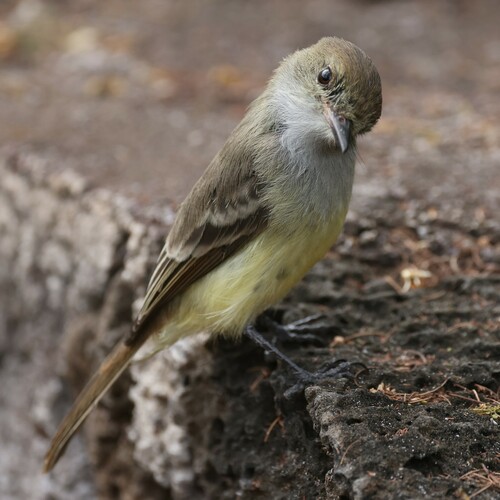
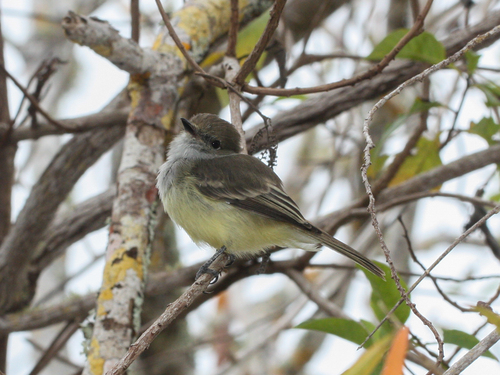
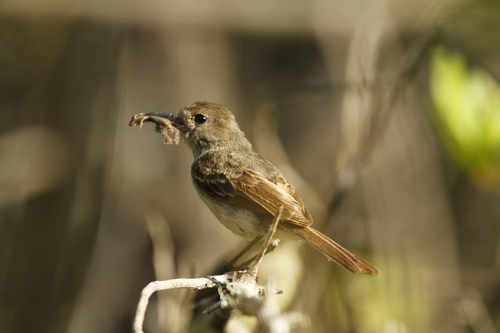
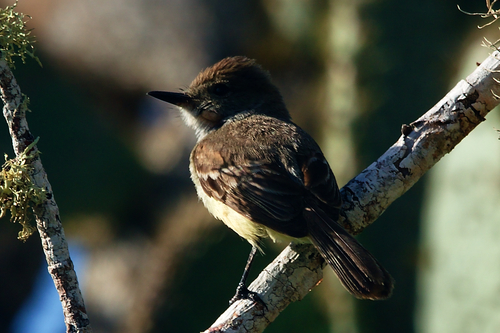
The Galapagos flycatcher is about 14 to 16 cm (5.5 to 6.3 in) long and weighs 12 to 18.5 g (0.42 to 0.65 oz). The sexes have the same plumage. Adults have a gray-brown to olive-brown crown whose feathers form a small crest. Their face is otherwise a lighter gray-brown. Their upperparts are mostly gray-brown to olive-brown with a brown rump. Their wings are mostly olive-brown to brown with paler edges on the primaries and secondaries and the wing's coverts have paler tips that show as two wing bars. Their tail is gray-brown with rufescent edges on the feathers. Voice: The Galapagos flycatcher's call is a "liquid wheet-wheet-wheet" and it has "a melodious song".
Text from Wikipedia, licensed CC BY-SA 4.0.
When to see the Galapagos Flycatcher
One bar for each month. Filled bars are the 11 months with records; pale bars are months with none. The wide bar is July, the month with the most records.
Where to see the Galapagos Flycatcher
The map shades 1 country with regular records. Everything unshaded has no records. Countries are listed below the map.
About the Galapagos Flycatcher
The Galapagos flycatcher, also known as the large-billed flycatcher, is a species of bird in the family Tyrannidae, the tyrant flycatcher. It is endemic to the Galápagos Islands.
Text adapted from Wikipedia, licensed CC BY-SA 4.0.
Easily confused with
 Yucatan FlycatcherMyiarchus yucatanensisThe Yucatan flycatcher is 17.5 to 19 cm (6.9 to 7.5 in) long and weighs 19 to 23 g (0.67 to 0.81 oz).
 Apical FlycatcherMyiarchus apicalisThe apical flycatcher is a typical representative of the Myiarchus flycatchers: a slim, medium-sized bird with few really distinctive features.
 Stolid FlycatcherMyiarchus stolidusThe stolid flycatcher is 20 cm (7.9 in) long and weighs about 19 to 26 g (0.67 to 0.92 oz).
Side by side: Apical Flycatcher vs Galapagos Flycatcher · Galapagos Flycatcher vs Yucatan Flycatcher · Galapagos Flycatcher vs Stolid Flycatcher
Learn the Galapagos Flycatcher in the BeakBrain App
Photo and call practice. Coming soon to iPhone and Android.
Play today's Daily BirdEvery photo and recording on this page is credited to its author under the licence shown. Spotted a problem with this page, or have a better photo? Contribute.