Learn what every symbol on the card means.Full credits and sources at beakbrain.com/symbols
 ForestDomed nestSmall · 40 g

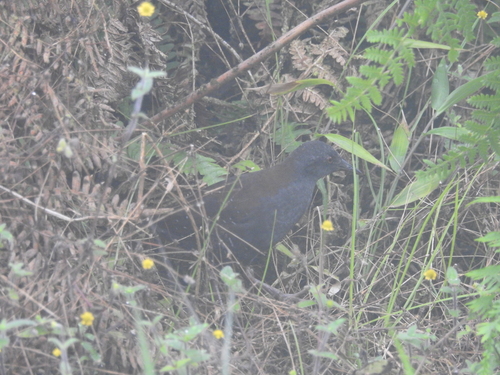
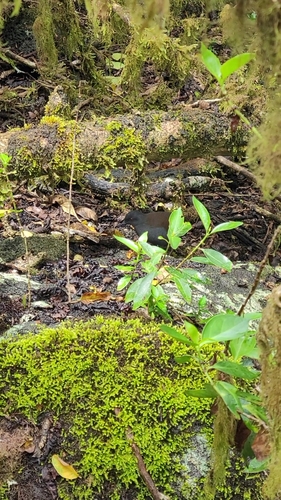
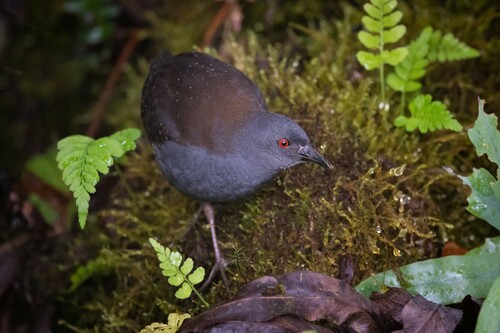
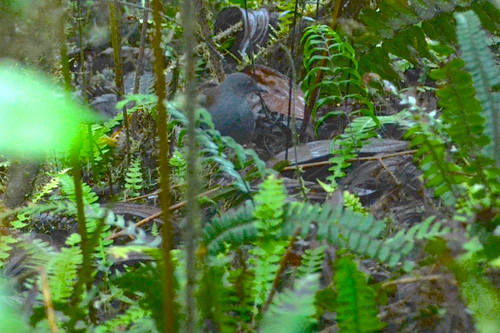
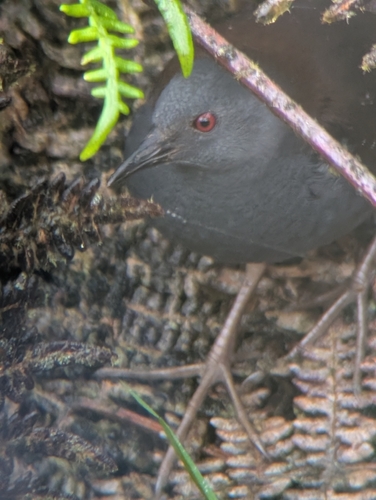
ID tip
The Galapagos crake is about 15 cm (5.9 in) long and weighs about 35 to 45 g (1.2 to 1.6 oz). The sexes are alike. Adults have a dark gray crown and medium gray head and underparts. Their flanks and thighs have sparse narrow whitish bars. Their interscapulars, scapulars, and upper back are chestnut brown and the lower back, rump, uppertail coverts, and tail are dark brown. Their upper wing coverts also are brown, and may have fine white spots, and their flight feathers are light brown. Their iris is a distinctive red, and the bill, tarsi, and toes are dark brown. Voice: The Galapagos crake gives at least five vocalizations, "cheeping, a chichichichiroo call, a chirr call, a chatter call, and a rattle call". They variously are used for members of a family to maintain contact, to advertise territory, and to intimidate predators.
Text from Wikipedia, licensed CC BY-SA 4.0.
When to see the Galapagos Crake
One bar for each month. Filled bars are the 11 months with records; pale bars are months with none. The wide bar is July, the month with the most records.
Where to see the Galapagos Crake
The map shades 1 country with regular records. Everything unshaded has no records. Countries are listed below the map.
About the Galapagos Crake
The Galapagos crake, also called the Galapagos rail and Darwin's rail, is a vulnerable species of rail in subfamily Rallinae of family Rallidae, the rails, gallinules, and coots. It is endemic to the Galápagos Islands. It resembles its sister species, the black rail of the Americas, from which it diverged 1.2 million years ago.
Text adapted from Wikipedia, licensed CC BY-SA 4.0.
Easily confused with
 Dot-winged CrakeLaterallus spilopteraThe dot-winged crake is 14 to 15 cm (5.5 to 5.9 in) long.
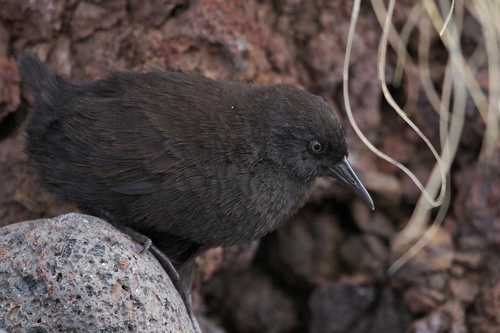 Inaccessible Island RailLaterallus rogersiVoice: The Inaccessible Island rail is a highly vocal species, calling frequently.
Learn the Galapagos Crake in the BeakBrain App
Photo and call practice. Coming soon to iPhone and Android.
Play today's Daily BirdEvery photo and recording on this page is credited to its author under the licence shown. Spotted a problem with this page, or have a better photo? Contribute.