Learn what every symbol on the card means.Full credits and sources at beakbrain.com/symbols
 ForestCup nestTiny · 6 g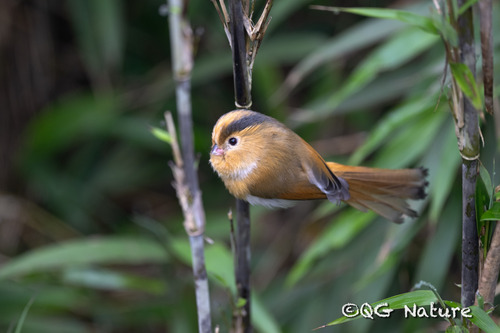

ID tip
The species is small, 12 to 12.5 cm (4.7–4.9 in) in length. The plumage of the nominate is dominated by a rich buff head, upper wing coverts, flanks, rump and tail. The belly is white and the face is dominated by a black stripe above the eye that gets larger towards the middle and then smaller again, and a faint white stripe below the face. The sexes are alike; the juvenile resembles the adult but is darker, particularly below. P. f. chayulensis has a paler belly than the nominate, P. f. albifacies has a darker stripe above the eye, and P. f.
Text from Wikipedia, licensed CC BY-SA 4.0.
When to see the Fulvous Parrotbill
One bar for each month. Filled bars are the 6 months with records; pale bars are months with none. The wide bar is May, the month with the most records.
Where to see the Fulvous Parrotbill
The map shades 4 countries with regular records. Everything unshaded has no records. Countries are listed below the map.
About the Fulvous Parrotbill
The fulvous parrotbill is a species of parrotbill in the family Paradoxornithidae. The species is also known as the fulvous-fronted parrotbill, the fulvous-fronted suthora, and the fulvous-fronted crowtit. The species, along with several others from the genus Suthora, is sometimes placed in the genus Paradoxornis. The species has four subspecies; the nominate subspecies from central Nepal, Bhutan and north-east India; P. f. chayulensis from north India and south China; P. f. albifacies from north Burma and nearby south China, and P. f. cyanophrys from central China.
Text adapted from Wikipedia, licensed CC BY-SA 4.0.
Easily confused with
 Short-tailed ParrotbillSuthora davidianaThe short-tailed parrotbill is a species of bird in the family Paradoxornithidae.
 Ashy-throated ParrotbillSuthora alphonsianaThe ashy-throated parrotbill is a parrotbill.
 Pale-billed ParrotbillSuthora atrosuperciliarisThe pale-billed parrotbill tends to be about 14-15 centimeters in height, and are recognized due to their fatter appearance, short tail, and color scheme.
Learn the Fulvous Parrotbill in the BeakBrain App
Photo and call practice. Coming soon to iPhone and Android.
Play today's Daily BirdEvery photo and recording on this page is credited to its author under the licence shown. Spotted a problem with this page, or have a better photo? Contribute.