Learn what every symbol on the card means.Full credits and sources at beakbrain.com/symbols
 GrasslandCup nestSmall · 32 g




What the Fork-tailed Flycatcher sounds like

ID tip
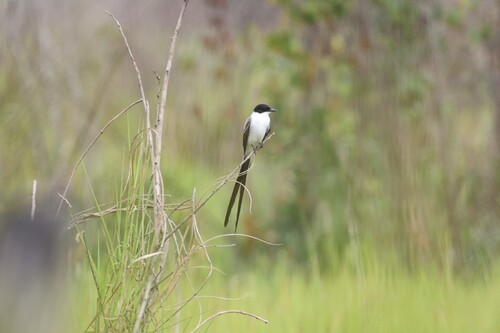
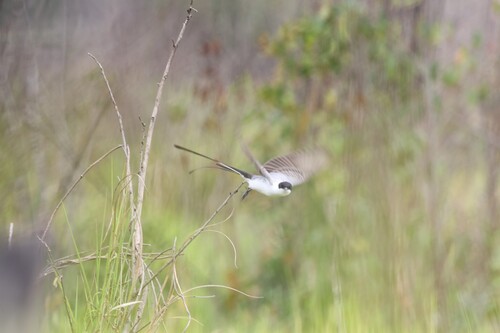
The fork-tailed flycatcher is white below, gray above, and has a black cap. Males sometimes show a yellow crown stripe. Males also have an extremely long, forked tail, of even greater length than that of the related scissor-tailed flycatcher. Females have a somewhat shorter tail, and it is significantly shorter in juveniles. Males are 37–41 cm (15–16 in) in length; females, 28–30 cm (11–12 in), including tail. They weigh only 28–32 g (0.99–1.13 oz), much less than closely related kingbirds, which are half the total length of this species. Voice: Fork-tailed flycatchers produce both vocal and nonvocal sounds. In general, they have a dry, buzzy call, and a weak "tic-note" while in flight. Their wings have been observed to make a distinct whistling note while flying overhead. Research has uncovered differences in the pitch of whistling noises by different subspecies of T. savana.
Text from Wikipedia, licensed CC BY-SA 4.0.
When to see the Fork-tailed Flycatcher
One bar for each month. Filled bars are the 8 months with records; pale bars are months with none. The wide bar is October, the month with the most records.
Where to see the Fork-tailed Flycatcher
The map shades 35 countries with regular records, and 2 more in a lighter tone where the bird turns up only as a stray. Everything unshaded has no records. Countries are listed below the map.
Recorded as a rare visitor in Canada, Cayman Islands.
About the Fork-tailed Flycatcher
The fork-tailed flycatcher is a passerine bird of the tyrant flycatcher family and is a member of a genus typically referred to as kingbirds. Named for the long, forked tail, particularly in males, fork-tailed flycatchers are seen in shrubland, savanna, lightly forested and grassland areas, from southern Mexico to Argentina. They are frequently observed on conspicuous perches whence they sally after insect prey. Northern populations near southern Mexico tend to be permanent residents, while fork-tailed flycatchers that live further south are migrants with a reputation for wandering as far north as New Brunswick, Canada.
Text adapted from Wikipedia, licensed CC BY-SA 4.0.
Easily confused with
 Couch's KingbirdTyrannus couchiiCouch's kingbird is about 7 inches long.
 Grey KingbirdTyrannus dominicensisThe adult gray kingbird is an average-sized kingbird.
 Loggerhead KingbirdTyrannus caudifasciatusThe loggerhead kingbird has a length of 24 to 26 cm (9.4 to 10.2 in), and is a large species of kingbird with a heavy bill.
Side by side: Cassin's Kingbird vs Fork-tailed Flycatcher · Fork-tailed Flycatcher vs Scissor-tailed Flycatcher · Fork-tailed Flycatcher vs Grey Kingbird · Couch's Kingbird vs Fork-tailed Flycatcher · Fork-tailed Flycatcher vs Loggerhead Kingbird
Learn the Fork-tailed Flycatcher in the BeakBrain App
Photo and call practice. Coming soon to iPhone and Android.
Play today's Daily BirdEvery photo and recording on this page is credited to its author under the licence shown. Spotted a problem with this page, or have a better photo? Contribute.