Learn what every symbol on the card means.Full credits and sources at beakbrain.com/symbols
 WoodlandCavity nestMedium · 241 g
What the Forest Owlet sounds like


ID tip
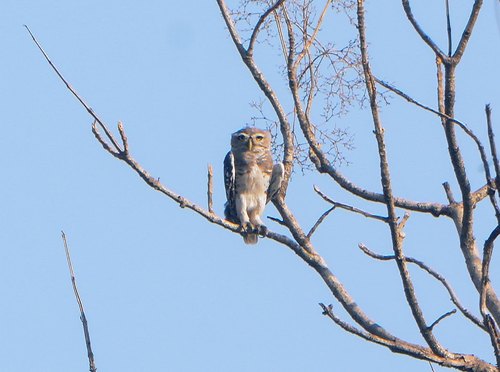
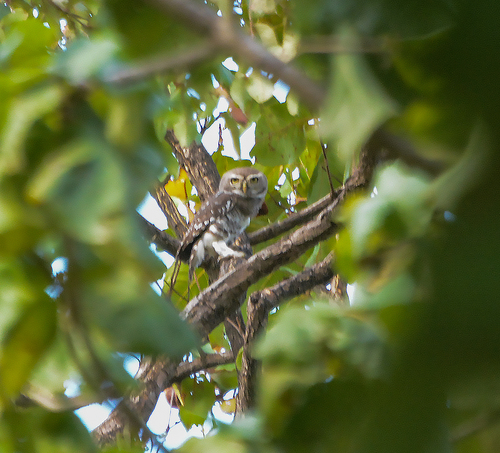
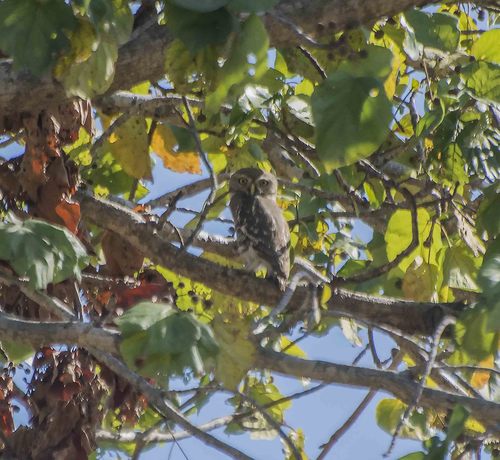
The forest owlet is small (23 cm) and stocky. It is a typical owlet with a rather unspotted crown and heavily banded wings and tail. They have a relatively large skull and beak. Unlike the spotted owlet, the forest owlet has the fewer and fainter spots on the crown and back. The upperparts are dark grey-brown. The upper breast is almost solid brown and the sides are barred with a white central wedge in the lower breast that is sometimes unmarked, especially in males. The primaries are darker and distinct. The wings and tail are banded with white trailing edges. Voice: They make several different calls, which include a hissing call of short duration. The song calls are short and mellow unlike those of most owls. They are usually disyllabic, "oh-owow" but sound monosyllabic and each note ascends and descends rapidly. The territorial calls have been transcribed as "kwaak … kk, kwaa..kk".
Text from Wikipedia, licensed CC BY-SA 4.0.
When to see the Forest Owlet
One bar for each month. Filled bars are the 8 months with records; pale bars are months with none. The wide bar is January, the month with the most records.
Where to see the Forest Owlet
The map shades 1 country with regular records. Everything unshaded has no records. Countries are listed below the map.
About the Forest Owlet
The forest owlet is endemic to the forests of central India. It is listed as Endangered on the IUCN Red List since 2018, as the population is estimated at fewer than 1,000 mature individuals. It is threatened foremost by deforestation.
Text adapted from Wikipedia, licensed CC BY-SA 4.0.
Easily confused with
 White-browed OwlAthene superciliarisThe white-browed owl is a dumpy owl with a large, rounded head which does not have ear tufts.
Guadalcanal OwlAthene grantiThe Guadalcanal owl, also known as the Guadalcanal boobook is a small to medium-sized owl.
White-browed OwlAthene superciliarisThe white-browed owl is a dumpy owl with a large, rounded head which does not have ear tufts.
Guadalcanal OwlAthene grantiThe Guadalcanal owl, also known as the Guadalcanal boobook is a small to medium-sized owl.
 West Solomons OwlAthene jacquinotiThe West Solomons owl, also referred to as the West Solomons boobook, is a small to medium-sized owl, measuring 23–31 cm (9.1–12.2 in) in length.
Learn the Forest Owlet in the BeakBrain App
Photo and call practice. Coming soon to iPhone and Android.
Play today's Daily BirdEvery photo and recording on this page is credited to its author under the licence shown. Spotted a problem with this page, or have a better photo? Contribute.