Learn what every symbol on the card means.Full credits and sources at beakbrain.com/symbols
 RiverineCavity nestSmall · 37 g


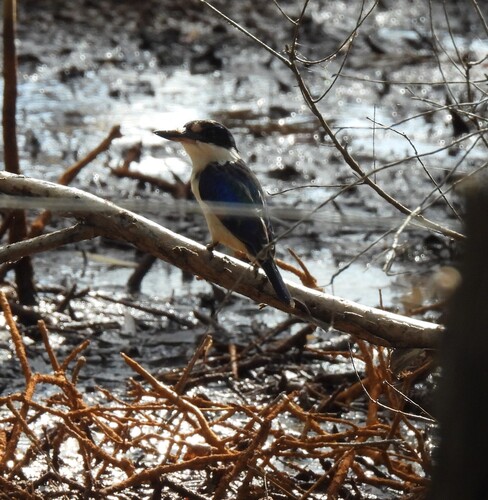
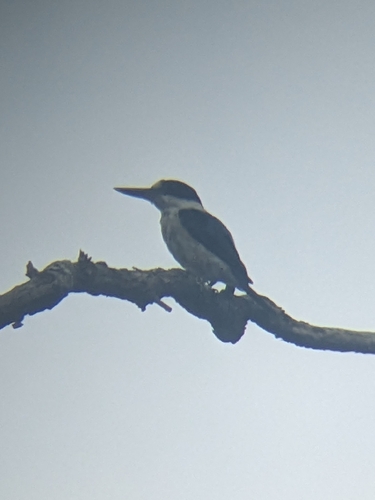
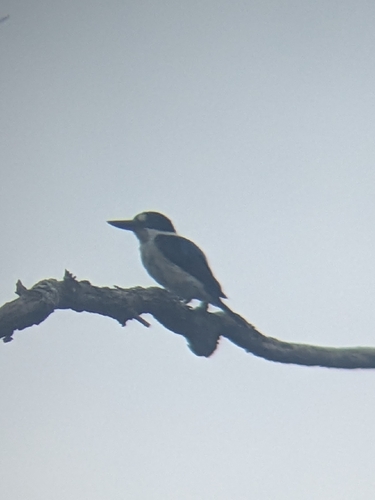

ID tip
The forest kingfisher measures 21.5–25.5 cm (8.5–10.0 in) in length and the male weighs 32–43 g (1.1–1.5 oz) while the female weighs 29–44 g (1.0–1.6 oz). It has blue wings, head and tail with white breast, abdomen and nape. It has a white patch in front of the eyes and a black band stretching from the bill, through the eyes to the ear coverts. A white patch is visible on the wings in flight. The female is distinguished by a blue rather than white nape. The iris is dark brown and the legs and feet dark grey. Immature birds are duller with a blackish crown.
Text from Wikipedia, licensed CC BY-SA 4.0.
When to see the Forest Kingfisher
One bar for each month, and every month is filled: this bird is recorded here in all twelve. The wide bar is October, the month with the most records.
Where to see the Forest Kingfisher
The map shades 3 countries with regular records. Everything unshaded has no records. Countries are listed below the map.
About the Forest Kingfisher
The forest kingfisher, also known as Macleay's or the blue kingfisher, is a species of kingfisher in the subfamily Halcyoninae, also known as tree kingfishers. It is a predominantly a blue and white bird. It is found in Indonesia, New Guinea and coastal eastern and Northern Australia. Like many other kingfishers, it hunts invertebrates, small frogs, and lizards.
Text adapted from Wikipedia, licensed CC BY-SA 4.0.
Easily confused with
 Collared KingfisherTodiramphus chlorisThe collared kingfisher is 23 to 25 cm (9.1 to 9.8 in) long and the male weighs 51 to 90 g (1.8 to 3.2 oz), while the female weighs 54–100 g (1.9–3.5 oz).
 Red-backed KingfisherTodiramphus pyrrhopygiusThe red-backed kingfisher measures 20 to 24 cm (7.9 to 9.4 in); the male weighs 45–70 g (1.6–2.5 oz) and the female 41–62 g (1.4–2.2 oz).
 Torresian KingfisherTodiramphus sordidusThe Torresian kingfisher is a species of bird in the family Alcedinidae.
Side by side: Forest Kingfisher vs Sacred Kingfisher · Collared Kingfisher vs Forest Kingfisher · Forest Kingfisher vs Red-backed Kingfisher
Learn the Forest Kingfisher in the BeakBrain App
Photo and call practice. Coming soon to iPhone and Android.
Play today's Daily BirdEvery photo and recording on this page is credited to its author under the licence shown. Spotted a problem with this page, or have a better photo? Contribute.