Learn what every symbol on the card means.Full credits and sources at beakbrain.com/symbols
 ForestCup nestTiny · 14 g


ID tip
The forest canary is a small bird with a short, thick beak, measuring 11–13 cm in length and weighing 10-14 g. The male and female are identifiable by their differences in color. The feathers on the back and wings of the male are yellow with a slight green tint, while the female has a greenish-gray color with yellow on its underparts. Both the male and female have a black mask that trails from the forehead to the eyes, as well as being marked with multiple black streaks on their upper parts. The juvenile forest canary is similar in appearance to the female, with a dull olive hue.
Text from Wikipedia, licensed CC BY-SA 4.0.
When to see the Forest Canary
One bar for each month, and every month is filled: this bird is recorded here in all twelve. The wide bar is October, the month with the most records.
Where to see the Forest Canary
The map shades 2 countries with regular records. Everything unshaded has no records. Countries are listed below the map.
About the Forest Canary
The forest canary is a species of finch in the family Fringillidae. It is found in South Africa and Eswatini. Its natural habitats are subtropical or tropical moist lowland forest and subtropical or tropical moist montane forest.
Text adapted from Wikipedia, licensed CC BY-SA 4.0.
Easily confused with
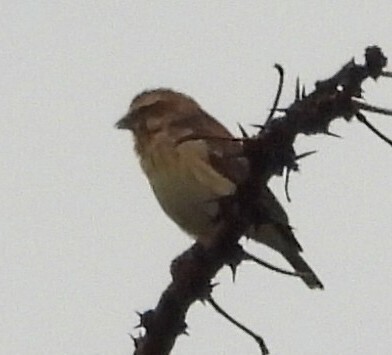 Reichenow's SeedeaterCrithagra reichenowiReichenow's seedeater is a species of finch in the family Fringillidae.
 Streaky SeedeaterCrithagra striolataThe streaky seedeater is a species of finch in the family Fringillidae.
 Cape SiskinCrithagra tottaThe Cape siskin averages 13 cm in length.
Side by side: Forest Canary vs White-throated Canary · Cape Siskin vs Forest Canary
Learn the Forest Canary in the BeakBrain App
Photo and call practice. Coming soon to iPhone and Android.
Play today's Daily BirdEvery photo and recording on this page is credited to its author under the licence shown. Spotted a problem with this page, or have a better photo? Contribute.