Learn what every symbol on the card means.Full credits and sources at beakbrain.com/symbols
 ShrublandDomed nestTiny · 12 g


ID tip
The fire-tailed myzornis is a small species of warbler-like bird, 11–13 cm (4.3–5.1 in) long and weighing 10–13 g (0.35–0.46 oz). It has bright green plumage with a black mask around the eyes and black scalloping on the crown. The wing is black and white with a streak of bright red and the sides of the tail are bright red. The bill is long, slightly curved and black. It is usually silent, but has a high-pitched tsi-tsit call.
Text from Wikipedia, licensed CC BY-SA 4.0.
When to see the Fire-tailed Myzornis
One bar for each month. Filled bars are the 8 months with records; pale bars are months with none. The wide bar is April, the month with the most records.
Where to see the Fire-tailed Myzornis
The map shades 5 countries with regular records. Everything unshaded has no records. Countries are listed below the map.
About the Fire-tailed Myzornis
The fire-tailed myzornis is a species of bird. Its genus Myzornis is monotypic, and has recently been transferred to the family Paradoxornithidae, having formerly been treated in the family Timaliidae.
Text adapted from Wikipedia, licensed CC BY-SA 4.0.
Easily confused with
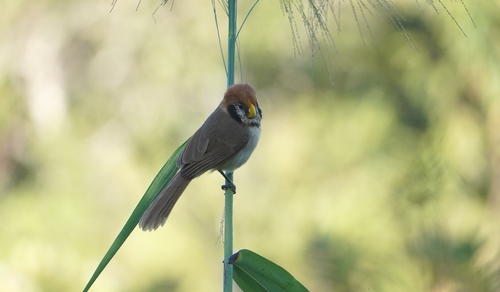 Spot-breasted ParrotbillParadoxornis guttaticollisThe spot-breasted parrotbill is a species of bird in the family Paradoxornithidae.
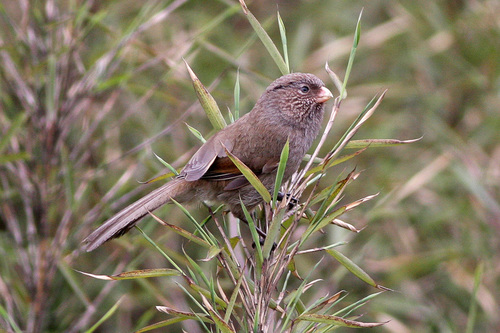 Brown ParrotbillParadoxornis unicolorThe brown parrotbill is a parrotbill found in the central and eastern Himalayas.
 White-breasted ParrotbillParadoxornis ruficepsThe white-breasted parrotbill is a bird species often placed with the Old World babblers or in a distinct family Paradoxornithidae, but it actually seems to belong to the Sylviidae.
Learn the Fire-tailed Myzornis in the BeakBrain App
Photo and call practice. Coming soon to iPhone and Android.
Play today's Daily BirdEvery photo and recording on this page is credited to its author under the licence shown. Spotted a problem with this page, or have a better photo? Contribute.