Learn what every symbol on the card means.Full credits and sources at beakbrain.com/symbols
 ForestSmall · 37 g
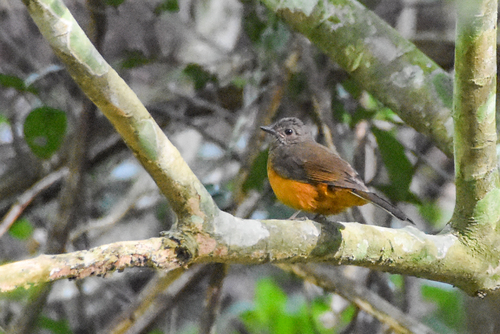
ID tip
Finsch's flycatcher-thrushes are 18 to 20 cm (7.1 to 7.9 in) long. Adults are brown above and orangish below, more gray or olive on the nape and breast and more rufous at the rear of the body. The tail is dark brown with white corners. The cheeks and throat are pale with gray and orange tints. Immatures are undescribed. The voice is similar to that of the rufous flycatcher-thrush. In Liberia it sings from May to October. The song is four melodious whistles, "hooee, hooee hooee-huEE, slower and lower-pitched than song of Rufous Flycatcher Thrush".
Text from Wikipedia, licensed CC BY-SA 4.0.
When to see the Finsch's Rufous Thrush
One bar for each month. Filled bars are the 7 months with records; pale bars are months with none. The wide bar is March, the month with the most records.
Where to see the Finsch's Rufous Thrush
The map shades 6 countries with regular records. Everything unshaded has no records. Countries are listed below the map.
About the Finsch's Rufous Thrush
Finsch's rufous thrush, also known as Finsch's flycatcher-thrush, Finsch's rusty flycatcher, Finsch's ant thrush or Finsch's rufous ant thrush, is a little-known flycatcher-like thrush of West African forests. It is often considered a subspecies of Fraser's rufous thrush.
Text adapted from Wikipedia, licensed CC BY-SA 4.0.
Easily confused with
Learn the Finsch's Rufous Thrush in the BeakBrain App
Photo and call practice. Coming soon to iPhone and Android.
Play today's Daily BirdEvery photo and recording on this page is credited to its author under the licence shown. Spotted a problem with this page, or have a better photo? Contribute.