Learn what every symbol on the card means.Full credits and sources at beakbrain.com/symbols
 Forest34 g
ID tip
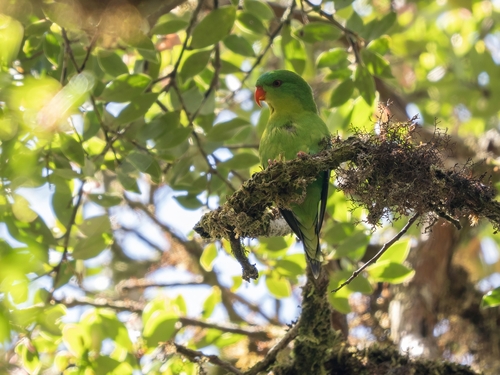
The fairy lorikeet grows to a length of about 18 cm (7 in) and weighs between 24 and 34 g (0.8 and 1.2 oz). The male of the nominate subspecies, C. p. pulchella, has the head, nape, breast and underparts red, the breast sometimes being streaked with yellow. The back of the crown has a purplish spot. The mantle, back and wings are dark green, as are the upper tail coverts. The upper side of the tail is green tipped with yellow and the central tail feathers are red towards their tips. The underside of the tail is yellow and the thighs are dark purple.
Text from Wikipedia, licensed CC BY-SA 4.0.
When to see the Fairy Lorikeet
One bar for each month. Filled bars are the 6 months with records; pale bars are months with none. The wide bar is August, the month with the most records.
Where to see the Fairy Lorikeet
The map shades 2 countries with regular records. Everything unshaded has no records. Countries are listed below the map.
About the Fairy Lorikeet
The fairy lorikeet is a species of parrot in the family Psittaculidae. Other common names include the little red lorikeet and the little red lory. Found in New Guinea, its natural habitats are subtropical or tropical moist lowland forests and subtropical or tropical moist montane forests. Its colouration is mainly red with some yellow on the throat and green on the wings. Two subspecies are recognised, C. p. pulchella and C. p. rothschildi.
Text adapted from Wikipedia, licensed CC BY-SA 4.0.
Easily confused with
Learn the Fairy Lorikeet in the BeakBrain App
Photo and call practice. Coming soon to iPhone and Android.
Play today's Daily BirdEvery photo and recording on this page is credited to its author under the licence shown. Spotted a problem with this page, or have a better photo? Contribute.