Learn what every symbol on the card means.Full credits and sources at beakbrain.com/symbols
 ForestCavity nestMedium · 65 g


What the Eurasian Three-toed Woodpecker sounds like


ID tip
The Eurasian three-toed woodpecker is 21–22 cm (8.3–8.7 in) in length, just a little smaller than the great spotted woodpecker. The adult has black and white plumage except for the yellow crown of the male. Neither sex has any red feathers. It has black wings and rump, and white from the throat to the belly; the flanks are white with black bars. The back is white with black bars, and the tail is black with the white outer feathers barred with black. Juveniles of both sexes have a yellow crown.
Text from Wikipedia, licensed CC BY-SA 4.0.
When to see the Eurasian Three-toed Woodpecker
One bar for each month. Filled bars are the 11 months with records; pale bars are months with none. The wide bar is June, the month with the most records.
Where to see the Eurasian Three-toed Woodpecker
The map shades 30 countries with regular records, and 2 more in a lighter tone where the bird turns up only as a stray. Everything unshaded has no records. Countries are listed below the map.
Recorded as a rare visitor in United States, St. Pierre & Miquelon.
About the Eurasian Three-toed Woodpecker
The Eurasian three-toed woodpecker is a medium-sized woodpecker that is found from northern Europe across northern Asia to Japan.
Text adapted from Wikipedia, licensed CC BY-SA 4.0.
Easily confused with
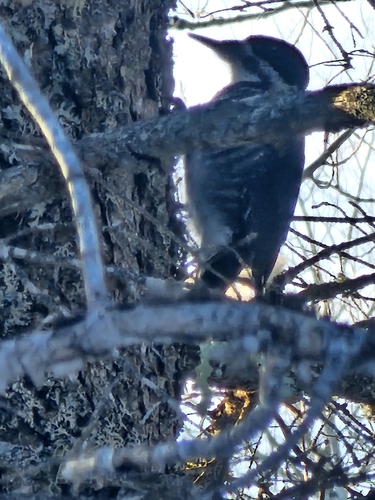 Black-backed WoodpeckerPicoides arcticusThe plumage of adults is black on the head, back, wings and rump.
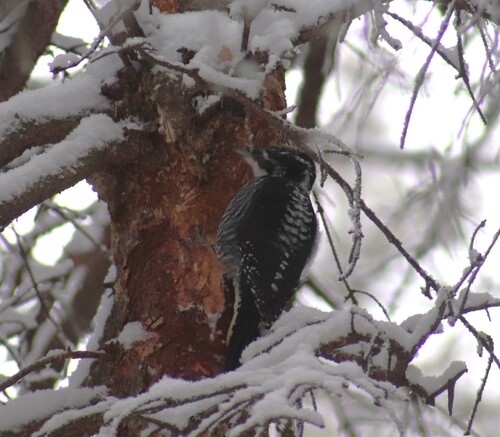 American Three-toed WoodpeckerPicoides dorsalisThis woodpecker has a length between 21 – 23 cm (8.3 – 9.1 in) and a wingspan between 37 – 39 cm (14.6 – 15.3 in).
Side by side: Black-backed Woodpecker vs Eurasian Three-toed Woodpecker · American Three-toed Woodpecker vs Eurasian Three-toed Woodpecker
Learn the Eurasian Three-toed Woodpecker in the BeakBrain App
Photo and call practice. Coming soon to iPhone and Android.
Play today's Daily BirdEvery photo and recording on this page is credited to its author under the licence shown. Spotted a problem with this page, or have a better photo? Contribute.