Learn what every symbol on the card means.Full credits and sources at beakbrain.com/symbols
 WetlandScrapeMedium · 82 g


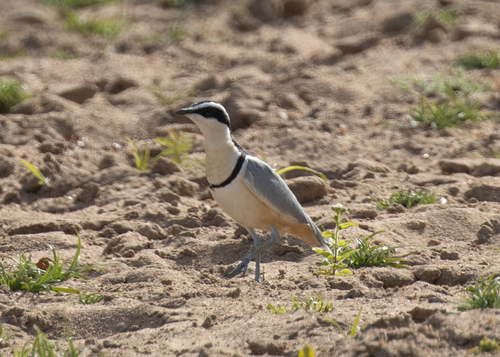


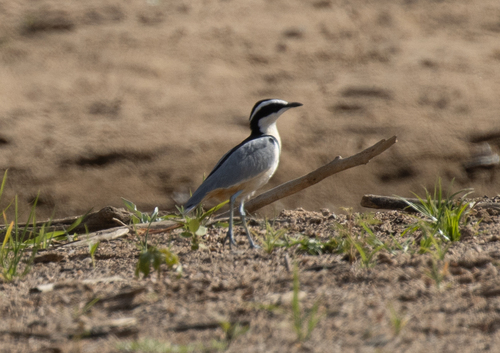
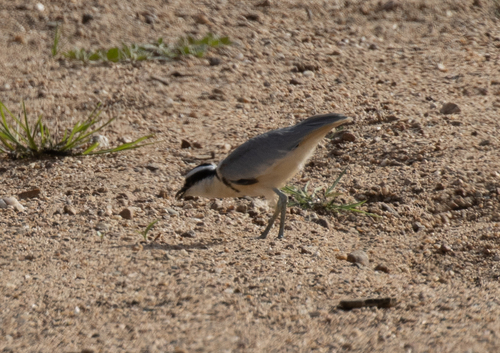
ID tip
The Egyptian plover is a striking and unmistakable species. The 19–21 cm (7.5–8.3 in) long adult has a black crown, back, eye-mask and breast band. The rest of the head is white. The remaining upperpart plumage is blue-grey, and the underparts are buff. The longish legs are blue-grey. The sexes are similar but juveniles are duller and the black marking are intermixed with brown. There is no seasonal variation. In flight the black crown and back contrast with the grey of the upperparts and wings. The flight feathers are brilliant white crossed by a black bar.
Text from Wikipedia, licensed CC BY-SA 4.0.
When to see the Egyptian Plover
One bar for each month. Filled bars are the 7 months with records; pale bars are months with none. The wide bar is December, the month with the most records.
Where to see the Egyptian Plover
The map shades 23 countries with regular records, and 3 more in a lighter tone where the bird turns up only as a stray. Everything unshaded has no records. Countries are listed below the map.
Recorded as a rare visitor in Mauritania, Spain, France.
About the Egyptian Plover
The Egyptian plover, also known as the crocodile bird, is a wader, the only member of the genus Pluvianus. It occurs in a band across Sub-Saharan Africa from Senegal in the west to Ethiopia in the east and south to parts of the Democratic Republic of the Congo. Despite the name, it no longer occurs in Egypt. The species was formerly placed with the pratincoles and coursers in the family, Glareolidae, but is now regarded as the sole member of its own monotypic family Pluvianidae.
Text adapted from Wikipedia, licensed CC BY-SA 4.0.
Learn the Egyptian Plover in the BeakBrain App
Photo and call practice. Coming soon to iPhone and Android.
Play today's Daily BirdEvery photo and recording on this page is credited to its author under the licence shown. Spotted a problem with this page, or have a better photo? Contribute.