Learn what every symbol on the card means.Full credits and sources at beakbrain.com/symbols


What the Ecuadorian Rail sounds like

ID tip
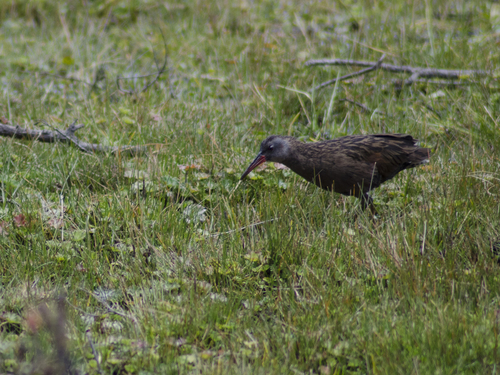
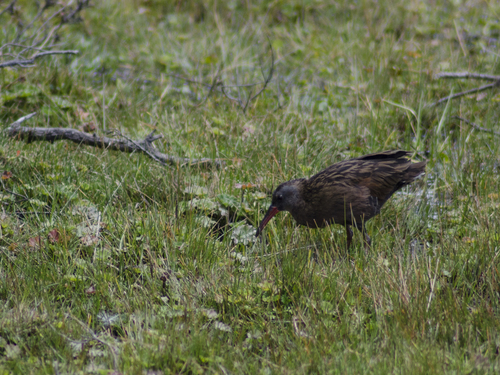
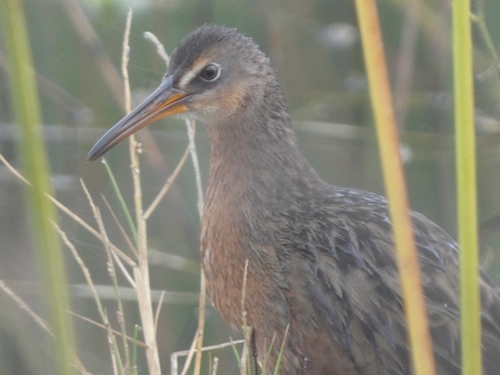
The Ecuadorian rail is 20 to 21 cm (7.9 to 8.3 in) long and weighs about 85 g (3.0 oz). The sexes are alike. Adults have a long, slightly decurved, bill that is reddish brown with a bright orange base. Their legs are dull orange. They have brown upperparts with blackish streaking and much rufous on the wing coverts. Their face and the sides of the neck are bluish gray and their throat white. Their underparts are dull cinnamon-buff with black and white barring on the flanks. Voice: As of late 2022, xeno-canto had no recordings of Ecuadorian rail vocalizations and the Cornell Lab of Ornithology's Macaulay Library had 10. Its calls are described as "a descending series of squeals and grunts" with a higher pitch than those of the Virginia rail.
Text from Wikipedia, licensed CC BY-SA 4.0.
When to see the Ecuadorian Rail
One bar for each month. Filled bars are the 11 months with records; pale bars are months with none. The wide bar is January, the month with the most records.
Where to see the Ecuadorian Rail
The map shades 2 countries with regular records. Everything unshaded has no records. Countries are listed below the map.
About the Ecuadorian Rail
The Ecuadorian rail is a species of bird according to the International Ornithological Committee (IOC), AOS, and Clements checklist, but other taxonomic systems treat it as a subspecies of the Virginia rail. It is in subfamily Rallinae of family Rallidae, the rails, gallinules, and coots. It is found in Colombia, Ecuador, and Peru.
Text adapted from Wikipedia, licensed CC BY-SA 4.0.
Easily confused with


Learn the Ecuadorian Rail in the BeakBrain App
Photo and call practice. Coming soon to iPhone and Android.
Play today's Daily BirdEvery photo and recording on this page is credited to its author under the licence shown. Spotted a problem with this page, or have a better photo? Contribute.