Learn what every symbol on the card means.Full credits and sources at beakbrain.com/symbols
 ForestCup nestTiny · 3 g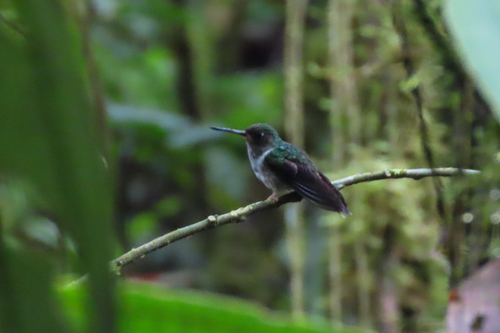
What the Ecuadorian Piedtail sounds like


ID tip
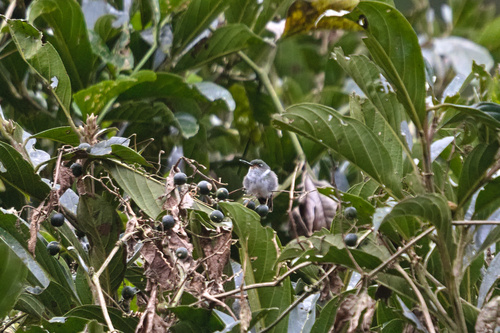
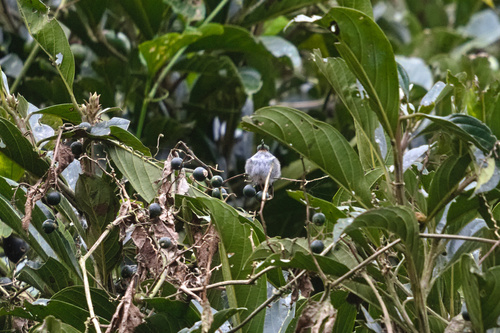
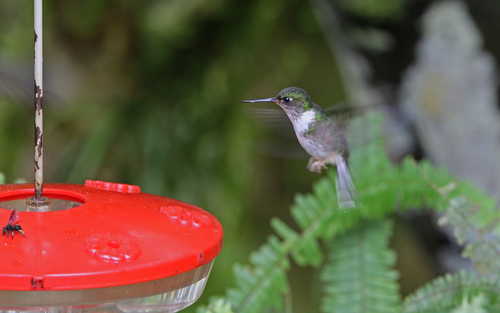
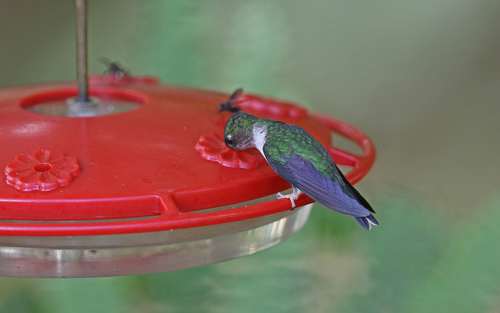
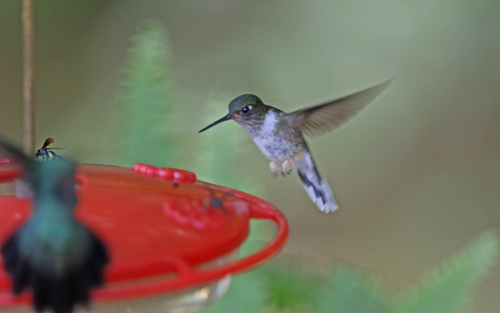
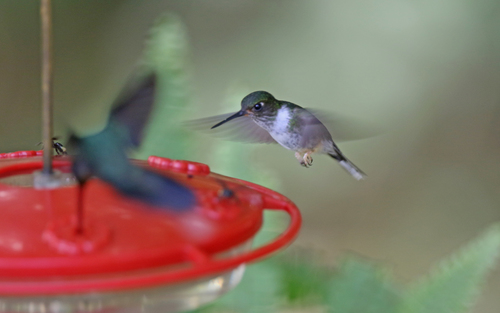
The Ecuadorian piedtail is 7.3 to 7.6 cm (2.9 to 3.0 in) long and weighs 2.2 to 3.7 g (0.078 to 0.13 oz). The adult male and female are alike. They have a short, straight, black bill with a yellowish base. Their crown is greenish brown and the rest of the upperparts grass green. They have a white spot behind the eye. The throat and breast are white with green spots with a white band separating them. The belly is whitish. The innermost pair of tail feathers are blue-green; the others are blue with white bases and broad white tips. Voice: The Ecuadorian piedtail's song is "a series of typically three high-pitched buzzy notes...followed by several twittering notes 'tzeeeee...tzeee.tzew..tititititi', continuously repeated." Its calls include "a descending series of 3–4 high-pitched 'see' notes..., a repeated 'tsik' note and high-pitched twittering."
Text from Wikipedia, licensed CC BY-SA 4.0.
When to see the Ecuadorian Piedtail
One bar for each month, and every month is filled: this bird is recorded here in all twelve. The wide bar is January, the month with the most records.
Where to see the Ecuadorian Piedtail
The map shades 3 countries with regular records. Everything unshaded has no records. Countries are listed below the map.
About the Ecuadorian Piedtail
The Ecuadorian piedtail is a species of hummingbird in the "coquettes", tribe Lesbiini of subfamily Lesbiinae. It is found in Colombia, Ecuador, and Peru.
Text adapted from Wikipedia, licensed CC BY-SA 4.0.
Easily confused with

Learn the Ecuadorian Piedtail in the BeakBrain App
Photo and call practice. Coming soon to iPhone and Android.
Play today's Daily BirdEvery photo and recording on this page is credited to its author under the licence shown. Spotted a problem with this page, or have a better photo? Contribute.