Learn what every symbol on the card means.Full credits and sources at beakbrain.com/symbols
 GrasslandPlatform nestLarge · 759 g


When to see the Eastern Buzzard
One bar for each month. Filled bars are the 7 months with records; pale bars are months with none. The wide bar is January, the month with the most records.
Where to see the Eastern Buzzard
The map shades 21 countries with regular records, and 1 more in a lighter tone where the bird turns up only as a stray. Everything unshaded has no records. Countries are listed below the map.
Recorded as a rare visitor in Malaysia.
About the Eastern Buzzard
The eastern buzzard or Japanese buzzard is a medium to large bird of prey that is sometimes considered a subspecies of the widespread common buzzard. Some scientists treated it as a distinct species starting in 2008, but others still treat it as either one or three subspecies. It is native to East Asia and some parts of Russia and South Asia, with some birds wintering in Southeast Asia. It is similar to the steppe buzzard. It is carnivorous.
Text adapted from Wikipedia, licensed CC BY-SA 4.0.
Easily confused with
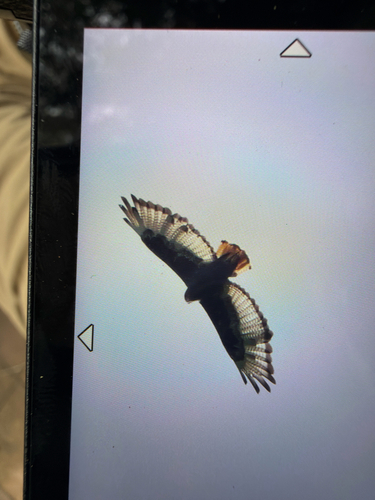 Augur BuzzardButeo augurAugur buzzards are one of two larger Buteo species native to Africa, alongside their cousins, the similarly sized jackal buzzard.
 Long-legged BuzzardButeo rufinusPaler individuals of the long-legged buzzard are typically reasonably distinctive but their highly variable plumage leads to mistaken identity.
 Himalayan BuzzardButeo refectusThe Himalayan buzzard is a medium to large bird of prey that is sometimes considered a subspecies of the widespread common buzzard.
Learn the Eastern Buzzard in the BeakBrain App
Photo and call practice. Coming soon to iPhone and Android.
Play today's Daily BirdEvery photo and recording on this page is credited to its author under the licence shown. Spotted a problem with this page, or have a better photo? Contribute.