Learn what every symbol on the card means.Full credits and sources at beakbrain.com/symbols
 ForestCavity nestMedium · 122 g




ID tip
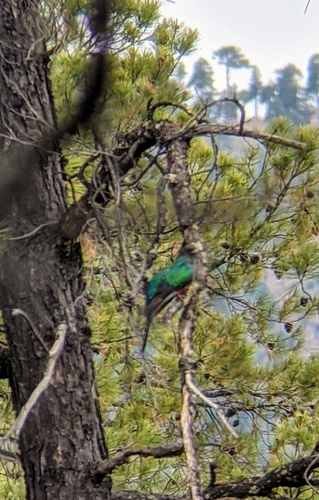
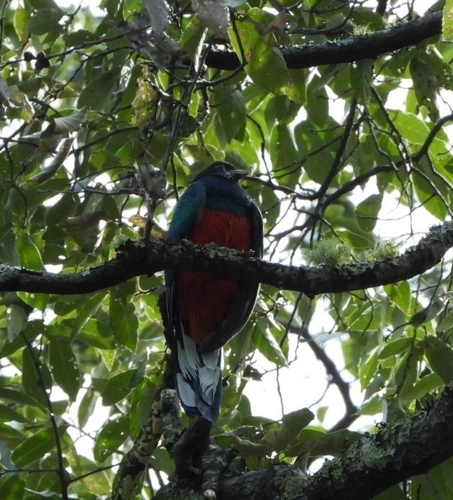
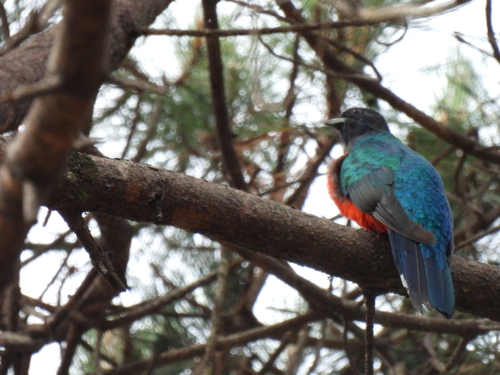
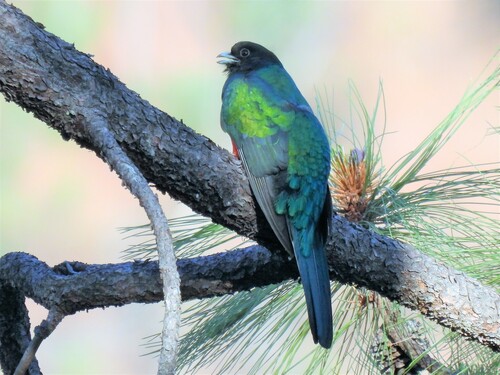
Its body length is 33–36 cm (13–14 in). Both sexes have iridescent green backs, iridescent dark blue central tail feathers, and outer tail feathers that are predominantly white terminally with a band of black at the base (sometimes partially barred black and white in females). The bill is dull gray with a slightly darker band at the tip. The adult male has a blackish head, iridescent green breast, and geranium red belly and undertail coverts. The adult female has a gray head, breast, and upper belly and less extensive (though equally bright) red on the lower belly.
Text from Wikipedia, licensed CC BY-SA 4.0.
When to see the Eared Quetzal
One bar for each month. Filled bars are the 6 months with records; pale bars are months with none. The wide bar is October, the month with the most records.
Where to see the Eared Quetzal
The map shades 1 country with regular records, and 1 more in a lighter tone where the bird turns up only as a stray. Everything unshaded has no records. Countries are listed below the map.
Recorded as a rare visitor in United States.
About the Eared Quetzal
The eared quetzal, also known as the eared trogon, is a species of bird in the trogon family, Trogonidae. It is native to streamside pine-oak forests and canyons in the Sierra Madre Occidental of Mexico from northern Sonora and Chihuahua south to western Michoacán. The species has occurred on rare occasions in southeastern Arizona, where it has been recorded nesting.
Text adapted from Wikipedia, licensed CC BY-SA 4.0.
Easily confused with
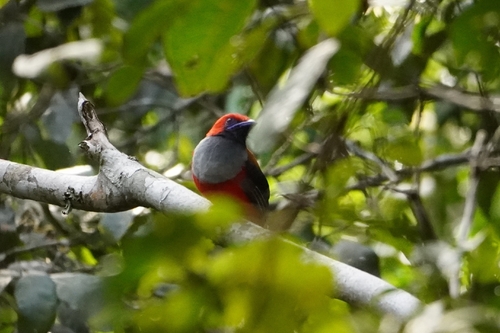 Whitehead's TrogonHarpactes whiteheadiLike most trogons, Whitehead's trogon is sexually dimorphic; the male is considerably more colorful than the female.
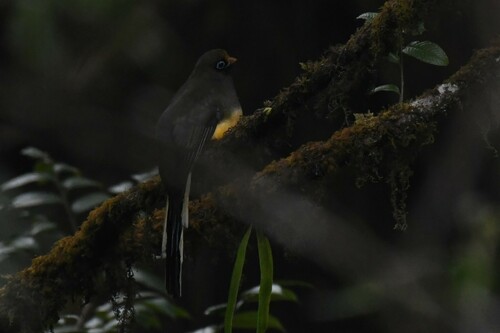 Ward's TrogonHarpactes wardiWard's trogon measures 35 to 38 cm (14–15 in) in length and weighs 115–120 g (4.1–4.2 oz).
 Hispaniolan TrogonPriotelus roseigasterTrogons are brightly coloured birds with long, strongly graduated tails, small feet, and short, thick bills.
Learn the Eared Quetzal in the BeakBrain App
Photo and call practice. Coming soon to iPhone and Android.
Play today's Daily BirdEvery photo and recording on this page is credited to its author under the licence shown. Spotted a problem with this page, or have a better photo? Contribute.