Learn what every symbol on the card means.Full credits and sources at beakbrain.com/symbols
 ForestPlatform nestHuge · 35.0 kg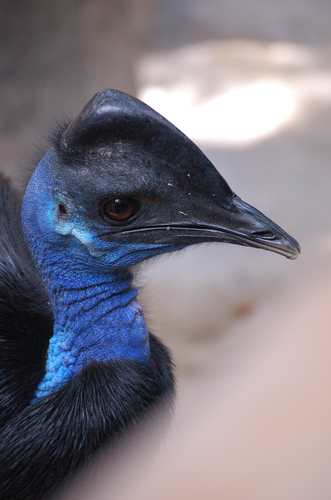
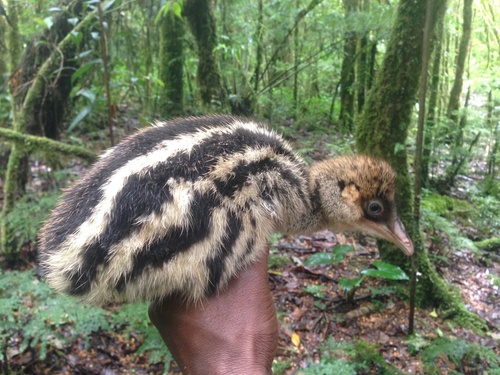


ID tip
The dwarf cassowary is a large bird but is smaller than other living cassowaries (the southern cassowary and northern cassowary). It is between 99 and 150 cm (3 ft 3 in and 4 ft 11 in) long and weighs between 17.6 and 26 kg (39 and 57 lb) It is a flightless bird with hard and stiff black plumage, a low triangular casque, pink cheek and red patches of skin on its blue neck. Compared to other cassowaries, the dwarf cassowary is shorter, with a tarsi length of 24.5 cm (9.6 in), with a slightly smaller bill, at 11 to 12.2 cm (4.3 to 4.8 in).
Text from Wikipedia, licensed CC BY-SA 4.0.
When to see the Dwarf Cassowary
One bar for each month. Filled bars are the 8 months with records; pale bars are months with none. The wide bar is July, the month with the most records.
Where to see the Dwarf Cassowary
The map shades 2 countries with regular records. Everything unshaded has no records. Countries are listed below the map.
About the Dwarf Cassowary
The dwarf cassowary, also known as Bennett's cassowary, little cassowary, mountain cassowary or muruk, is the smallest of the three extant species of cassowaries. Like all cassowaries, it is a mostly black, large flightless bird.
Text adapted from Wikipedia, licensed CC BY-SA 4.0.
Easily confused with
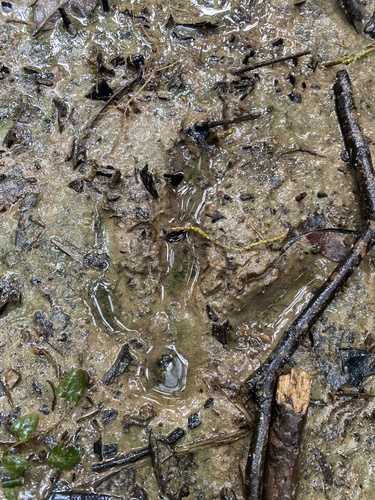 Northern CassowaryCasuarius unappendiculatusThe northern cassowary has a hard and stiff black plumage, blue facial skin and a casque on top of the head.
 Southern CassowaryCasuarius casuariusThe adult southern cassowary has stiff, bristly black plumage, a blue face and a long neck, red on the cape and two red wattles measuring up to 18 cm (7.1 in) in length hanging down around its throat.
Learn the Dwarf Cassowary in the BeakBrain App
Photo and call practice. Coming soon to iPhone and Android.
Play today's Daily BirdEvery photo and recording on this page is credited to its author under the licence shown. Spotted a problem with this page, or have a better photo? Contribute.