Learn what every symbol on the card means.Full credits and sources at beakbrain.com/symbols
 ForestCavity nestSmall · 27 g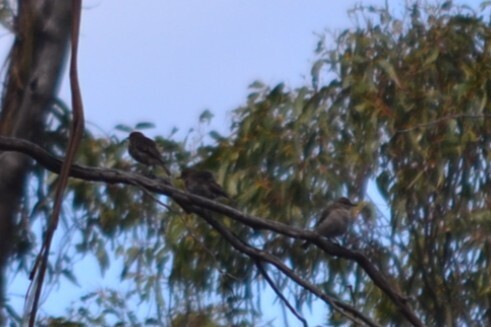
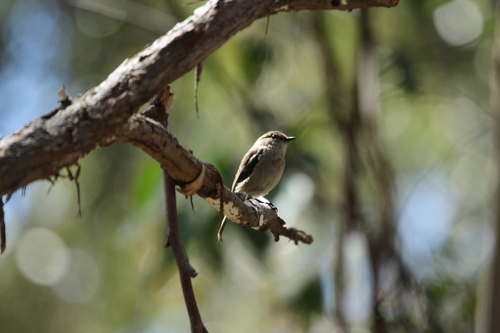
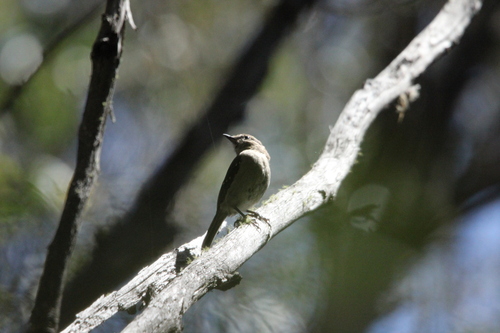

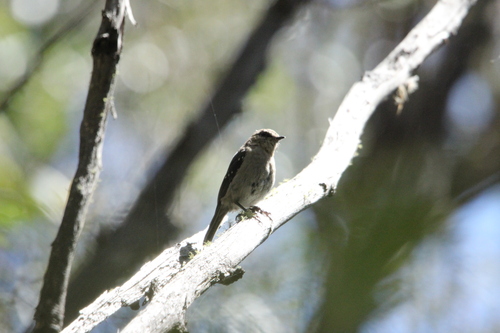
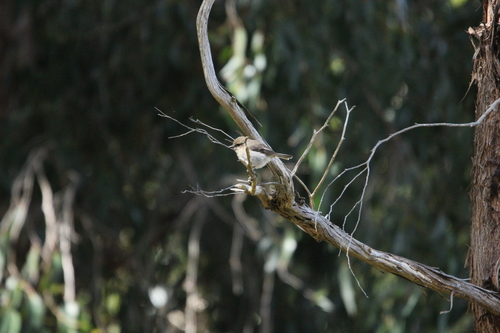
ID tip
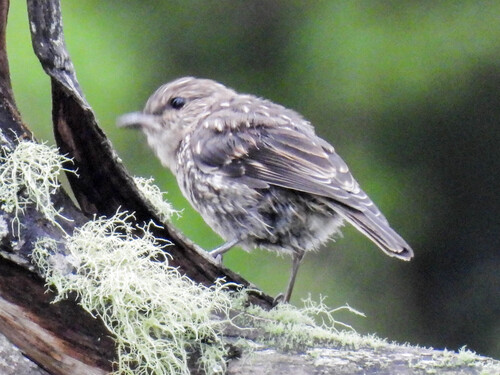
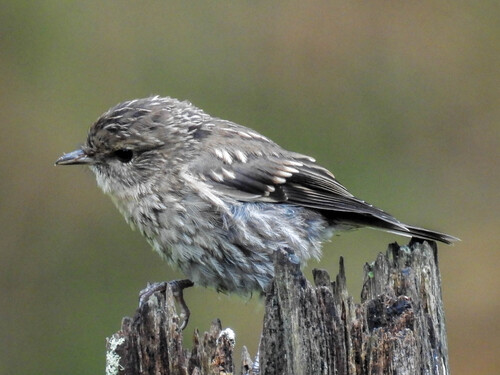
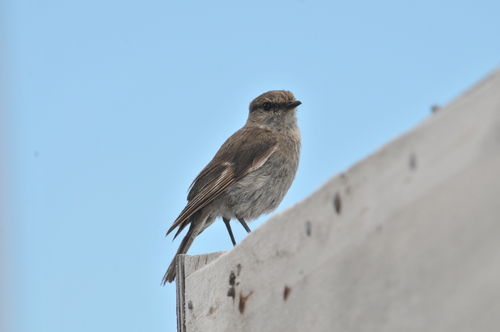
Measuring from 14-16.5 centimetres in length, and weight around 27 grams, the dusky robin lacks the bright colours of its robin relatives. The bird has short, slender bill and a moderately long tail, and it is much larger than other Petroicidae that occur in Tasmania. It is almost impossible to differentiate male from female in the field. They have no seasonal variation nor sexual dimorphism. However, there are large, noticeable differences between adults and juvenile dusky robins. Voice: The dusky robins are also known colloquially as the sad bird or sad robin due to its mournful, melancholic song. It is often described as low, monotonic Choo-wee, Choo-we-er, without any particular character, and its repertoire limited to a few low notes. They seldom sing, and it is more of an indication of their vivacity than musical taste.
Text from Wikipedia, licensed CC BY-SA 4.0.
When to see the Dusky Robin
One bar for each month. Filled bars are the 10 months with records; pale bars are months with none. The wide bar is November, the month with the most records.
Where to see the Dusky Robin
The map shades 1 country with regular records. Everything unshaded has no records. Countries are listed below the map.
About the Dusky Robin
The dusky robin is a small passerine bird native to Tasmania. A member of the Australian robin family Petroicidae, it is known by many other names such as Dozey, Sad, Sleepy, Stump, Tasmania/Wood Robin; Native Sparrow or Sad Bird.
Text adapted from Wikipedia, licensed CC BY-SA 4.0.
Easily confused with
 White-rumped RobinMelanodryas bimaculataMeasuring 13 to 14 cm (5.1 to 5.5 in), the white-rumped robin has black plumage with a white rump and upper tail coverts.
 Mangrove RobinMelanodryas pulverulentaThe mangrove robin has an average weight of 21.3 grams (0.75 oz) for males and 17.3 grams (0.61 oz) for females.
 White-winged RobinMelanodryas sigillataMeasuring 14 to 15 centimetres (5.5 to 5.9 in), the adult white-winged robin has black plumage, with largely white wings.
Side by side: Dusky Robin vs Hooded Robin
Learn the Dusky Robin in the BeakBrain App
Photo and call practice. Coming soon to iPhone and Android.
Play today's Daily BirdEvery photo and recording on this page is credited to its author under the licence shown. Spotted a problem with this page, or have a better photo? Contribute.