Learn what every symbol on the card means.Full credits and sources at beakbrain.com/symbols
 Forest


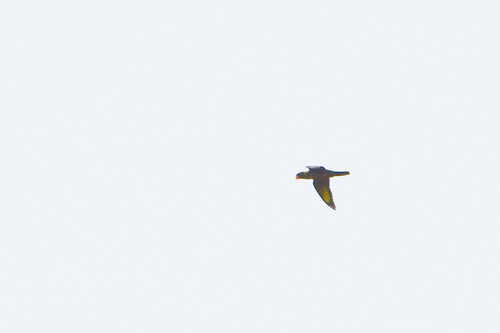
ID tip
The dusky lory is short-tailed parrot about 25cm (10in) long and weights around 300 grams. Both sexes are similar in appearance, with a dark brown to blackish head, neck, and back, two bright bands across the breast, and a pale whitish or cream rump. Their legs are grey, the bill is red, the irises range from red-orange to dark brown, and the beak is orange with an area of orange skin at the base of the lower mandible. The species exhibits no sexual dimorphism, meaning males and females are visually identical. To determine the sex of an individual, DNA analysis or surgical sexing are required. Voice: The vocal repertoire of these lories is varied, ranging from high-pitched, ringing screeches and metallic "pings" to softer warbles and continuous chattering, especially when gathered in large groups. Their flight calls are fast, ringing notes given in rapid succession. These social birds often travel in flocks of dozens to hundreds of individuals, maintaining constant vocal contact.
Text from Wikipedia, licensed CC BY-SA 4.0.
When to see the Dusky Lory
One bar for each month. Filled bars are the 7 months with records; pale bars are months with none. The wide bar is August, the month with the most records.
Where to see the Dusky Lory
The map shades 4 countries with regular records, and 3 more in a lighter tone where the bird turns up only as a stray. Everything unshaded has no records. Countries are listed below the map.
Recorded as a rare visitor in United States, Germany, United Kingdom.
About the Dusky Lory
The dusky lory is a species of parrot in the subfamily Loriinae of the family Psittaculidae. Alternative common names are the white-rumped lory or the dusky-orange lory. They are also known as "banded lories" or "duskies". It is also sometimes placed in the Chalcopsitta genus, but mitochondrial analyses prove that it truly belongs to the Pseudeos genus. It is native to New Guinea and the offshore islands of Batanta, Salawati and Yapen, where it inhabits a wide range of lowland and montane forest habitats.. Known for its distinctive dark plumage with bright orange or yellow breast bands, this lory is highly social and noisy, often seen flying in large flocks.
Text adapted from Wikipedia, licensed CC BY-SA 4.0.
Easily confused with
 Brown LoryChalcopsitta duivenbodeiThe brown lory has a black beak, yellow-streaked face, white tail and mostly dark brown plumage.
 Black LoryChalcopsitta atraThe black lory is 32 cm (13 in) long and has a black bill.
 Yellow-streaked LoryChalcopsitta scintillataThe yellow-streaked lory, also known as the streaked lory or yellowish-streaked lory, is a species of parrot in the family Psittaculidae.
Learn the Dusky Lory in the BeakBrain App
Photo and call practice. Coming soon to iPhone and Android.
Play today's Daily BirdEvery photo and recording on this page is credited to its author under the licence shown. Spotted a problem with this page, or have a better photo? Contribute.