Learn what every symbol on the card means.Full credits and sources at beakbrain.com/symbols
 ForestCavity nestSmall · 18 g


What the Dusky-capped Flycatcher sounds like


ID tip
The dusky-capped flycatcher is 16 to 18.5 cm (6.3 to 7.3 in) long and weighs 14 to 27 g (0.49 to 0.95 oz). The sexes have the same plumage. Adults of the nominate subspecies M. t. tuberculifer have a sooty brown crown and face; the crown feathers form a slight crest. Their upperparts are mostly dark greenish olive-brown with browner uppertail coverts. Their wings are mostly dusky with thin dull white edges on the secondaries and thin buffy-white edges on the inner primaries. Their greater and median wing coverts have buffy brown edges. Their tail is dark grayish brown. Voice: The dusky-capped flycatcher's vocalizations vary across its range. In Mexico its dawn song "consists of a long series of "sentences" made up of 2 or 3 elements". In much of Central America it is "a short, sharply whistled whit, a long drawn, plaintive, whistled wheeeu, and an emphatic whistle cut short". In much of South America it is "plaintive whistles alternated with huit notes".
Text from Wikipedia, licensed CC BY-SA 4.0.
When to see the Dusky-capped Flycatcher
One bar for each month, and every month is filled: this bird is recorded here in all twelve. The wide bar is May, the month with the most records.
Where to see the Dusky-capped Flycatcher
The map shades 20 countries with regular records. Everything unshaded has no records. Countries are listed below the map.
About the Dusky-capped Flycatcher
The dusky-capped flycatcher is a passerine bird in the family Tyrannidae, the tyrant flycatchers. It is found in the United States, Mexico, every Central American country, Trinidad, and in every mainland South American country except Chile, Paraguay, and Uruguay.
Text adapted from Wikipedia, licensed CC BY-SA 4.0.
Easily confused with
 Brown-crested FlycatcherMyiarchus tyrannulusThe brown-crested flycatcher is 18 to 23 cm (7.1 to 9.1 in) long, with a general trend of larger to smaller from north to south.
 Ash-throated FlycatcherMyiarchus cinerascensThe ash-throated flycatcher is a medium-sized tyrant flycatcher, measuring 7.5 to 8.6 in (19 to 22 cm) in length with a wingspan of 11.8 to 12.6 in (30 to 32 cm) and a mass of 0.7 to 1.3 oz (20 to 37 g).
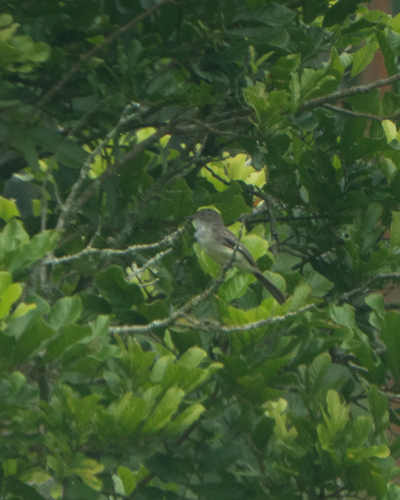 Short-crested FlycatcherMyiarchus feroxThe short-crested flycatcher is about 18 cm (7.1 in) long and weighs 21 to 34 g (0.74 to 1.2 oz).
Side by side: Dusky-capped Flycatcher vs Great Crested Flycatcher · Ash-throated Flycatcher vs Dusky-capped Flycatcher · Brown-crested Flycatcher vs Dusky-capped Flycatcher · Dusky-capped Flycatcher vs Short-crested Flycatcher
Learn the Dusky-capped Flycatcher in the BeakBrain App
Photo and call practice. Coming soon to iPhone and Android.
Play today's Daily BirdEvery photo and recording on this page is credited to its author under the licence shown. Spotted a problem with this page, or have a better photo? Contribute.