Learn what every symbol on the card means.Full credits and sources at beakbrain.com/symbols
 ForestPlatform nestMedium · 215 g


ID tip
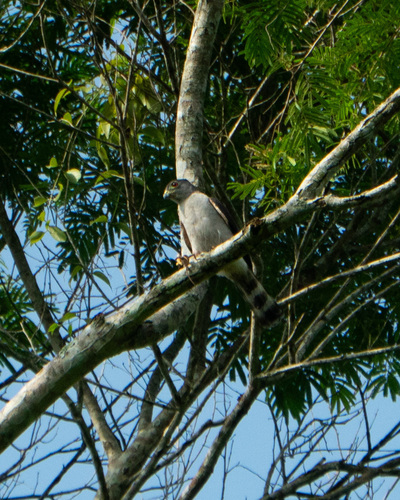
The double-toothed kite is 29 to 35 cm (11 to 14 in) long with a wingspan of 60 to 72 cm (24 to 28 in). Males weigh about 160 to 200 g (5.6 to 7.1 oz) and females about 190 to 230 g (6.7 to 8.1 oz). The species gets its English name from the tooth-like notches on the edge of its maxilla. Males and females have similar plumage though the females' colors are richer. Adults of both subspecies have a dark gray head with a white throat that has a dark stripe down its center. Their upperparts are a somewhat lighter gray and their tail blackish with three grayish bands and a gray tip. Voice: The double-toothed kite makes high-pitched calls "'tsip-tsip-tsip-tsip-wheeeeeoooip', extended 'wheeeeoooo' or 'cheeeeee-it'" in nest defence or other agonistic encounters. Pairs make contact calls described as "whistled 'see-weeeeep' or 'chee-weet'". Young beg with a "chee-weet" call.
Text from Wikipedia, licensed CC BY-SA 4.0.
When to see the Double-toothed Kite
One bar for each month, and every month is filled: this bird is recorded here in all twelve. The wide bar is March, the month with the most records.
Where to see the Double-toothed Kite
The map shades 18 countries with regular records, and 1 more in a lighter tone where the bird turns up only as a stray. Everything unshaded has no records. Countries are listed below the map.
Recorded as a rare visitor in United States.
About the Double-toothed Kite
The double-toothed kite is a species of bird of prey in subfamily Accipitrinae, the "true" hawks, of family Accipitridae. It is found from central Mexico through Central America into much of northern and eastern South America.
Text adapted from Wikipedia, licensed CC BY-SA 4.0.
Easily confused with
Side by side: Double-toothed Kite vs Gabar Goshawk
Learn the Double-toothed Kite in the BeakBrain App
Photo and call practice. Coming soon to iPhone and Android.
Play today's Daily BirdEvery photo and recording on this page is credited to its author under the licence shown. Spotted a problem with this page, or have a better photo? Contribute.