Learn what every symbol on the card means.Full credits and sources at beakbrain.com/symbols
 GrasslandScrapeMedium · 237 g


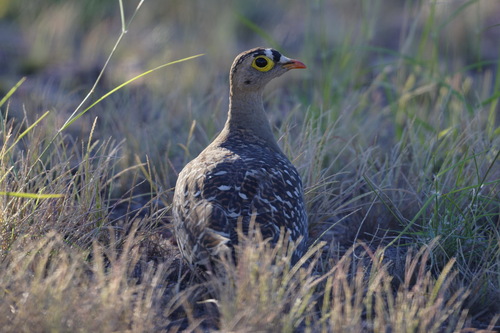


ID tip
A moderately-sized, quail-like bird with a plump body, the double-banded sandgrouse has a small, almost pigeon-like head with a long pair of wings and tail. The general colour of the plumage is light brown, with darker mottling and rows of whitish specks; the male is distinguished by having a conspicuous black-and-white band on his forehead, with a chestnut-coloured throat that is delineated by another black-and-white band. Both sexes have an area of bare, yellow skin surrounding their eyeball, and the male has an orange beak. The female is smaller and a more dull-brown in colour.
Text from Wikipedia, licensed CC BY-SA 4.0.
When to see the Double-banded Sandgrouse
One bar for each month, and every month is filled: this bird is recorded here in all twelve. The wide bar is August, the month with the most records.
Where to see the Double-banded Sandgrouse
The map shades 7 countries with regular records, and 1 more in a lighter tone where the bird turns up only as a stray. Everything unshaded has no records. Countries are listed below the map.
Recorded as a rare visitor in Nigeria.
About the Double-banded Sandgrouse
The double-banded sandgrouse is a species of predominantly terrestrial, or ground-dwelling, bird in the family Pteroclidae. It is found in arid parts of southern Africa.
Text adapted from Wikipedia, licensed CC BY-SA 4.0.
Easily confused with
 Namaqua SandgrousePterocles namaquaThe sandgrouse is a medium-sized bird with a plump body, small head and short legs.
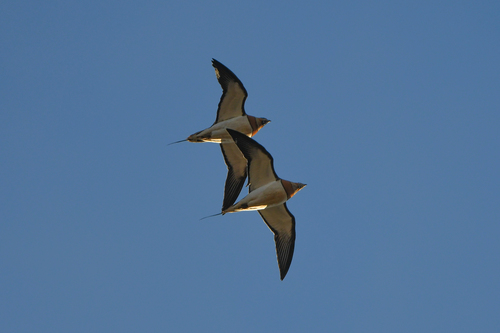 Pin-tailed SandgrousePterocles alchataThe pin-tailed sandgrouse is a robust, medium-sized bird about 31 to 39 centimetres (12 to 15 in) in length.
 Black-bellied SandgrousePterocles orientalisThe black-bellied sandgrouse is 33–39 cm (13–15 in) long and weighs 300–615 g (10.6–21.7 oz), it is likely the largest species in the sandgrouse family.
Side by side: Double-banded Sandgrouse vs Pin-tailed Sandgrouse · Double-banded Sandgrouse vs Namaqua Sandgrouse · Black-bellied Sandgrouse vs Double-banded Sandgrouse
Learn the Double-banded Sandgrouse in the BeakBrain App
Photo and call practice. Coming soon to iPhone and Android.
Play today's Daily BirdEvery photo and recording on this page is credited to its author under the licence shown. Spotted a problem with this page, or have a better photo? Contribute.