Learn what every symbol on the card means.Full credits and sources at beakbrain.com/symbols
 ForestDomed nestTiny · 8 g


What the Dot-winged Antwren sounds like


ID tip
The dot-winged antwren is 10 to 12.5 cm (3.9 to 4.9 in) long and weighs 7.5 to 11.5 g (0.26 to 0.41 oz). The species has a long graduated tail. The sexes have different plumage. Adults of the nominate subspecies M. q. quixensis are mostly black. They have a partly concealed white patch between their shoulders. Their greater wing coverts have large white tips and the other coverts smaller ones. Their wing's underside shows additional white areas. Their flight feathers are dark gray with a brown tinge. Voice: The dot-winged antwren's song varies among the subspecies and sexes but is generally "an accelerating series of notes that shorten in length". It is described as a "slightly accelerating tip-tip-Tip-Tip-Tip-Tip-Tip-Tip-teu-teu-teu-teu'teu" in northern Central America and "a series of high, fast notes, which rise initially in pitch and intensity before descending" in Costa Rica.
Text from Wikipedia, licensed CC BY-SA 4.0.
When to see the Dot-winged Antwren
One bar for each month, and every month is filled: this bird is recorded here in all twelve. The wide bar is March, the month with the most records.
Where to see the Dot-winged Antwren
The map shades 15 countries with regular records. Everything unshaded has no records. Countries are listed below the map.
About the Dot-winged Antwren
The dot-winged antwren or velvety antwren is a passerine bird in subfamily Thamnophilinae of family Thamnophilidae, the "typical antbirds". It is found in Mexico, every Central American country except El Salvador, Bolivia, Brazil, Colombia, Ecuador, French Guiana, Guyana, Peru, and Suriname.
Text adapted from Wikipedia, licensed CC BY-SA 4.0.
Easily confused with
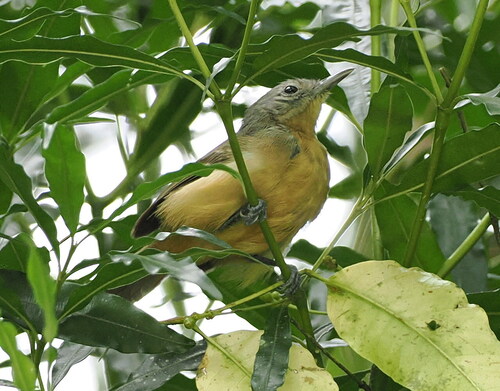 White-flanked AntwrenMyrmotherula axillarisThe white-flanked antwren is 9 to 10.5 cm (3.5 to 4.1 in) long and weighs 5 to 10.6 g (0.18 to 0.37 oz) with some variation in weight among the subspecies.
 Bar-crested AntshrikeThamnophilus multistriatusThe bar-crested antshrike is 15 to 16.5 cm (5.9 to 6.5 in) long and weighs 21 to 23 g (0.74 to 0.81 oz).
 Fasciated AntshrikeCymbilaimus lineatusThe fasciated antshrike is 17 to 18 cm (6.7 to 7.1 in) long and weighs 35 to 40 g (1.2 to 1.4 oz).
Side by side: Bar-crested Antshrike vs Dot-winged Antwren · Dot-winged Antwren vs Fasciated Antshrike
Learn the Dot-winged Antwren in the BeakBrain App
Photo and call practice. Coming soon to iPhone and Android.
Play today's Daily BirdEvery photo and recording on this page is credited to its author under the licence shown. Spotted a problem with this page, or have a better photo? Contribute.