Learn what every symbol on the card means.Full credits and sources at beakbrain.com/symbols
 WetlandSmall · 19 g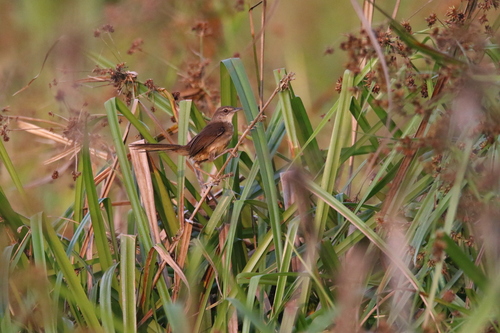


ID tip
The bird is mainly olive-brown and has a greyish and narrow supercillium. The chin and throat are white, and the tail is tawny brown. The breast has broad, black streaks. The upper manidble is black while the lower mandible is grey, and both the iris and the toes are brown in color. The juvenile is white below with no breast band and the upper breast is spotted. This species is similar to the little rush warbler, but the little rush warbler is smaller, has a finer bill, a more rounded tail and less prominent throat streaking. Voice: The song is similar to the Grauer's swamp warbler. It is a loud, descending trill psuit-psuit-psuit-its-struuuuuu or a higher pitched tsweet-tsweet-tsweet-its-struuuuuu.
Text from Wikipedia, licensed CC BY-SA 4.0.
When to see the Dja River Scrub Warbler
One bar for each month. Filled bars are the 9 months with records; pale bars are months with none. The wide bar is August, the month with the most records.
Where to see the Dja River Scrub Warbler
The map shades 3 countries with regular records. Everything unshaded has no records. Countries are listed below the map.
About the Dja River Scrub Warbler
The Dja River scrub warbler is a species of Old World warbler in the family Locustellidae. It is found in Cameroon, Central African Republic, and Gabon. Its natural habitat is swamps. It is threatened by habitat loss.
Text adapted from Wikipedia, licensed CC BY-SA 4.0.
Easily confused with
 Grey EmutailBradypterus seebohmiThe grey emutail, also known as the Madagascan grassbird or feather-tailed warbler, is an emutail in the family Locustellidae.
Bangwa Forest WarblerBradypterus bangwaensisIt does not exhibit physical sexual dimorphism.
Brown EmutailBradypterus brunneusThe brown emutail is an emutail in the family Locustellidae.
Grey EmutailBradypterus seebohmiThe grey emutail, also known as the Madagascan grassbird or feather-tailed warbler, is an emutail in the family Locustellidae.
Bangwa Forest WarblerBradypterus bangwaensisIt does not exhibit physical sexual dimorphism.
Brown EmutailBradypterus brunneusThe brown emutail is an emutail in the family Locustellidae.
Learn the Dja River Scrub Warbler in the BeakBrain App
Photo and call practice. Coming soon to iPhone and Android.
Play today's Daily BirdEvery photo and recording on this page is credited to its author under the licence shown. Spotted a problem with this page, or have a better photo? Contribute.