Learn what every symbol on the card means.Full credits and sources at beakbrain.com/symbols
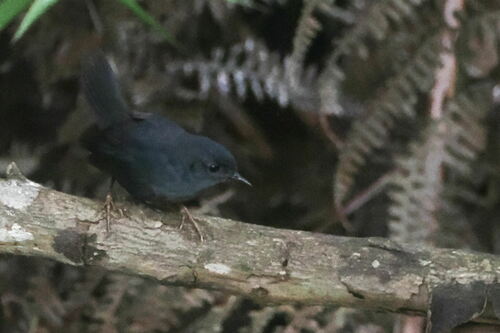
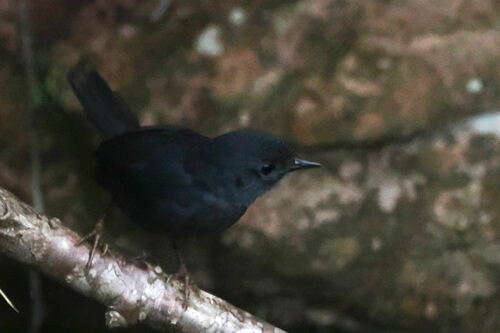
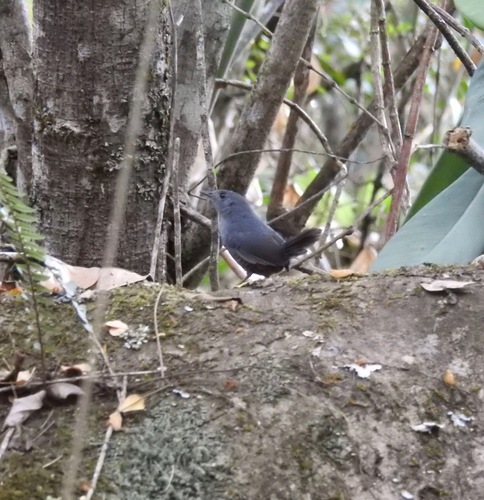


ID tip
The Diamantina tapaculo is approximately 10 to 11 cm (3.9 to 4.3 in) long and weighs approximately 15 g (0.53 oz). The adult's plumage is identical to that of the Planalto tapaculo. The male's upperparts are mainly dark gray and the underparts paler gray. The flanks are buff with dark bars, which differentiate it from the similar but unbarred mouse-colored tapaculo. The female is browner. Voice: The Diamantina tapaculo's song is a simple note, quickly repeated, often for more than a minute. Its call is unique, described as "a single 'tcheep' note".
Text from Wikipedia, licensed CC BY-SA 4.0.
When to see the Diamantina Tapaculo
One bar for each month. Filled bars are the 10 months with records; pale bars are months with none. The wide bar is January, the month with the most records.
Where to see the Diamantina Tapaculo
The map shades 1 country with regular records. Everything unshaded has no records. Countries are listed below the map.
About the Diamantina Tapaculo
The Diamantina tapaculo is a species of bird in the family Rhinocryptidae. It is endemic to northeastern Brazil.
Text adapted from Wikipedia, licensed CC BY-SA 4.0.
Easily confused with
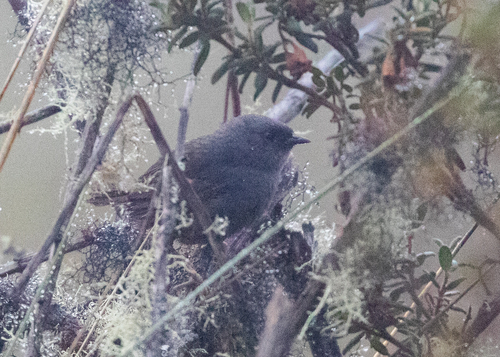 Jalca TapaculoScytalopus frankeaeLike all members of genus Scytalopus, the jalca tapaculo is a small, plump, dull-colored bird.
El Oro TapaculoScytalopus robbinsiThe Ecuadorian tapaculo or El Oro tapaculo is a small passerine bird belonging to the genus Scytalopus, a genus of tapaculos.
Marsh TapaculoScytalopus iraiensisIt is a small, dumpy bird with broad tail-feathers and a total length of approximately 12.5 cm.
Jalca TapaculoScytalopus frankeaeLike all members of genus Scytalopus, the jalca tapaculo is a small, plump, dull-colored bird.
El Oro TapaculoScytalopus robbinsiThe Ecuadorian tapaculo or El Oro tapaculo is a small passerine bird belonging to the genus Scytalopus, a genus of tapaculos.
Marsh TapaculoScytalopus iraiensisIt is a small, dumpy bird with broad tail-feathers and a total length of approximately 12.5 cm.
Learn the Diamantina Tapaculo in the BeakBrain App
Photo and call practice. Coming soon to iPhone and Android.
Play today's Daily BirdEvery photo and recording on this page is credited to its author under the licence shown. Spotted a problem with this page, or have a better photo? Contribute.